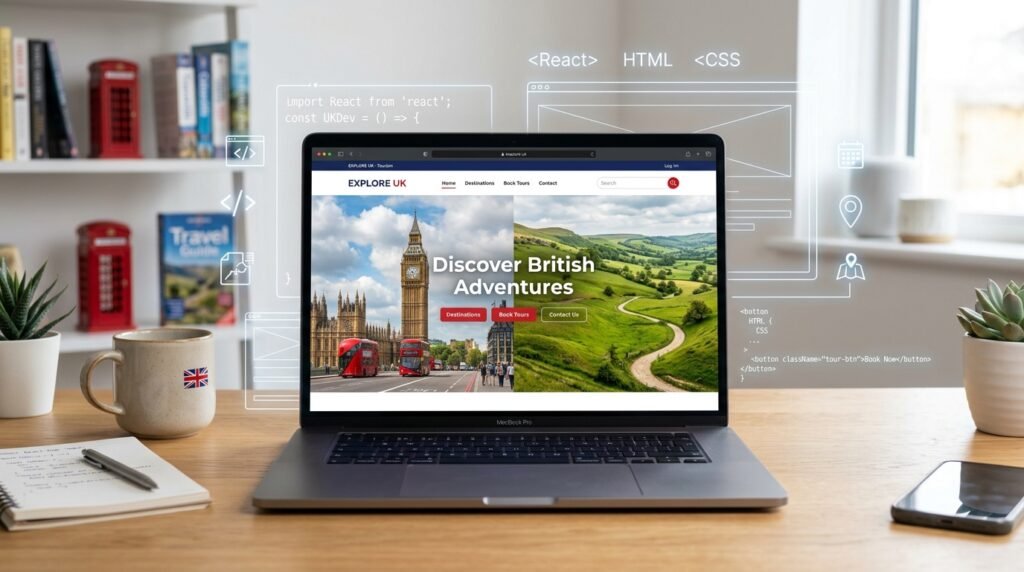





The UK tourism sector is booming, with industry benchmarks underscoring the importance of fast, engaging websites. Average travel sites see ~50% bounce rates and low conversion (0.2–4%), so optimised design and functionality are critical. Key website features include mobile-friendly layouts, intuitive booking engines (including multi-currency and payment gateways), and integration with APIs (e.g. mapping, CRM) to manage tours and bookings efficiently. Underlying tech stacks often combine CMS platforms (WordPress, Drupal), custom booking/payment modules, and PWA capabilities for offline access.
Building such sites requires a team: front-end developers (HTML/CSS/JavaScript) to craft the user interface, back-end developers (e.g. PHP, Node, Python) to handle data and server logic, and full-stack developers bridging both. UX/UI designers ensure the site is user-centric and accessible, while DevOps engineers manage hosting (e.g. AWS) and CI/CD pipelines. QA testers handle validation and performance checks.
Hiring choices range from freelancers (fast and flexible) to agencies (broad expertise) to in‑house staff (deep brand knowledge), each with pros/cons. Freelancers offer cost-effective, short-term support but may lack stability; agencies bring full teams and strategic oversight (at higher cost); in-house developers provide continuous engagement but entail full salaries and benefits. Offshore developers can lower costs but introduce communication and IP risks.
UK salary benchmarks (2026) are roughly: junior web dev £25–40K, mid £40–60K, senior £60–80K; front-end roles ~£44K–£73K, back-end ~£45K–£73K, full-stack ~£43K–£77K. Freelance rates vary (about £50–70/hr typical), with project budgets from ~£1K for simple sites to £20K+ for complex e-commerce.
Effective recruitment uses multiple channels: UK-based job boards (LinkedIn, Indeed, Reed), developer networks (GitHub, StackOverflow), and freelance platforms (Upwork, PeoplePerHour, Toptal). Interviews should combine technical tests (coding challenges, portfolio reviews) and cultural fit questions. A clear evaluation rubric (skills vs responsibilities) and legal safeguards (contracts, IP assignment) are essential.
A structured onboarding plan (see 90-Day Plan below) helps new hires ramp up quickly. Maintenance plans and SLAs (e.g. 99.9% uptime, security updates, backups) ensure site reliability post-launch. Key performance indicators (KPIs) like website traffic, booking conversion rate, bounce rate, and revenue per visitor should be tracked.
This report analyses these dimensions, showcases top UK tourism websites, and provides sample job briefs and templates. Actionable recommendations are summarised at the end, along with a 10-point hiring checklist to guide tourism businesses (London, Manchester, Birmingham, Leeds, Bristol, Edinburgh, Cambridge) in securing the right web development partner or employee.
Industry Benchmarks for UK Tourism Websites
UK tourism sites must stand out in a competitive market. Analytics benchmarks show travel websites average ~50.6% bounce rate (desktop) – meaning roughly half of visitors leave after one page. Top sites push this well below 25%. Mobile accounts for ~60% of traffic, so performance on smartphones is critical: industry-leading sites load <2.2s, whereas the average is ~3.9s.
Conversion rates for travel bookings are low industry-wide (often 0.2–4%). Achieving >2% conversion marks a high-performing site. Similarly, cart abandonment can exceed 80% if the booking path isn’t streamlined. Direct booking channels are especially valuable: research finds direct-booking revenue can be ~60% higher per booking than via OTAs. Thus, tourism businesses should prioritise seamless on-site booking with minimal friction (clear pricing, multiple payment methods, simple forms).
SEO metrics also matter. Tourism boards like Northern Ireland’s recommend Google PageSpeed scores ≥80 and mobile-friendly designs to rank well. UK travel sites should monitor Core Web Vitals and implement image optimisation, lazy loading, and caching to meet these standards. Link authority and domain rating are key too: in the travel sector, domain authority (DA) 50–60 is strong, >60 is excellent. Content quality, from detailed attractions guides to multilingual support, drives both SEO and user trust.
Key metrics to monitor: monthly unique visitors, SEO rankings, bounce rate, pages/session, time-on-site, and importantly booking conversion rate (bookings divided by visitors). Sites must also track average booking value, acquisition cost, and repeat-customer rates for revenue insights.
- Traffic and Engagement: Use Google Analytics and Search Console to track organic traffic growth.
- Speed and Performance: Target load times <3s on mobile, leverage CDNs and optimized images to improve speed.
- Booking Conversion: Ensure the booking funnel is intuitive. Industry tips suggest testing flows in Google Analytics and minimise steps if conversion lags.
- Mobile First: With Google’s mobile-first indexing, priority is on responsive design and touch-friendly forms (especially map selection and date pickers). Google’s Mobile-Friendly Test is a good diagnostic.
Essential Website Features & Tech Stack
Tourism websites require features that cater to travelers’ needs. At a minimum, sites should include:
- Responsive, Mobile-Friendly Design: Over 60% of travelers browse on phones. A responsive layout and PWA (Progressive Web App) support can make the site load instantly and even work offline, improving engagement. (PWA adoption has boosted sessions and conversions for travel brands.)
- Advanced Search and Filtering: Multi-criteria search (destination, date, price, ratings) is key. Users should quickly find tours or hotels via filters. Autocomplete (“search predictions”) in the search bar enhances UX.
- Booking Engine Integration: Real-time availability through APIs (e.g. GDS for flights, hotel PMS, or custom inventory) is vital. The booking process must be streamlined: intuitive date pickers, clear package details, and minimal steps to checkout. A disjointed flow causes cart abandonment.
- Secure Payment Gateways: Support major payments (Visa/Mastercard, PayPal, Stripe, etc.) and local wallets as needed. Compliance (PCI DSS) and SSL/TLS encryption build trust. Offering familiar payment logos can reduce drop-offs in travel bookings.
- Maps & Location APIs: Integration with Google Maps or similar allows users to visualize destinations and directions. Many tourism sites showcase “explore” maps of points of interest, enhancing planning.
- Content & Media: High-quality photos, videos, and interactive media (like 360° tours) improve engagement. Dynamic content (blogs, news of events) also aids SEO. For example, VisitBritain’s homepage features rich image carousels and video about “film and TV itineraries” to entice visitors.
- Multi-language/Locale Support: The UK sees global tourists. Sites often allow switching languages and currencies (as VisitLondon.com does), which improves international usability.
- CMS and SEO: A flexible Content Management System (e.g. WordPress, Drupal) lets teams update pages (itineraries, blog posts) quickly. Important SEO features (meta-tags editing, clean URLs) should be supported. For example, the Tourism Northern Ireland guide stresses tools like Yoast SEO on WordPress for travel sites.
- Scalability & Cloud Hosting: Tourism sites face seasonal traffic spikes. Using cloud infrastructure (AWS, Azure) with auto-scaling and CDN ensures reliable performance. DevOps setup (CI/CD pipelines, automated testing, containerization) speeds deployment and quality.
- Progressive Web App (PWA): PWAs blur the line between web and app, enabling “add to home screen” and offline availability. Travel sites (e.g. MakeMyTrip) report 3× more sessions and 160% higher conversions after PWA adoption. For UK tourism brands, a PWA could be an edge.
- Analytics & Reporting: Built-in dashboards for traffic, bookings, and user behavior are useful. Integration with Google Analytics and Tag Manager is standard, but custom dashboards (e.g. in the CMS) help tourism operators gauge ROI quickly.
Overall, the tech stack might include: Front-end: React/Vue/Angular or server-rendered pages with HTML5/CSS3/JS; Back-end: PHP (Laravel/WordPress), Node.js, or Python (Django) with a database (MySQL, MongoDB). APIs: Payment, maps, third-party travel data (weather, flights) can be integrated. Many travel sites also plug into CRM/ERP for lead management (e.g. Salesforce, custom CRM) and marketing automation (Mailchimp, HubSpot).
Ambient Infotech (as an example digital agency) offers comprehensive tourism web solutions: they emphasise “fast, secure, and scalable websites tailored to your business goals”. Their capabilities (e-commerce with Shopify/Magento, custom web apps, SEO marketing) illustrate what a full-service developer brings to the table. Tourism businesses should look for a provider comfortable with both technical (coding, hosting) and business sides (SEO, UX, conversion optimisation).
Developer Roles & Skillsets
Building and maintaining a tourism website typically involves a team with complementary roles and skills:
- Front-End Developer: Codes the user interface (UI). Proficient in HTML5, CSS3 (and preprocessors), JavaScript, and modern frameworks (React, Angular, Vue). Responsibilities include implementing responsive design, animations, and integrating UI with back-end APIs. They need a good eye for design and UX, often working closely with designers on mockups.
- Back-End Developer: Handles server-side logic, databases, and application architecture. Skills include PHP (Laravel/Drupal), Python (Django/Flask), Node.js, Ruby on Rails, or .NET. They implement booking engines, data models, and business rules. A back-end dev also ensures security (e.g. sanitising user input) and scalability (server performance, API rate limiting).
- Full-Stack Developer: Capable of both front-end and back-end tasks. Often takes on API integration, builds features end-to-end, and ties together the front-end with server logic. For smaller projects, a full-stack dev may cover much of the workload, but larger projects usually separate roles for specialization.
- UX/UI Designer: Focuses on user experience and interface design. Skilled with design tools (Figma, Sketch, Adobe XD), they create wireframes, prototypes, and visual designs. They conduct user research and testing to ensure the site is intuitive for tourists. For example, ensuring navigation clearly highlights “Book Tours” or “Find Hotels” to match user expectations in the travel context.
- DevOps Engineer / System Administrator: Manages servers, deployment pipelines, and cloud infrastructure. They set up hosting environments (AWS, Azure, Google Cloud), CI/CD (e.g. Jenkins, GitHub Actions), and monitor uptime/security. In the tourism sector, a DevOps engineer implements auto-scaling for peak travel seasons and configures CDNs and caching (e.g. Cloudflare) to handle high traffic without downtime.
- QA/Tester: Ensures quality and bug-free releases. Responsibilities include writing and executing test cases (unit tests, integration tests, end-to-end tests), performing cross-browser/device compatibility checks, and load/performance testing. A QA tester in a travel company might simulate booking flows, verifying that edge cases (e.g. expired credit cards, last-minute availability) are handled gracefully.
- Project Manager / Scrum Master: Though not coding, this role coordinates the team, plans sprints, and communicates with stakeholders. They ensure features (like a new booking widget or a content update) are delivered on time. For tourism sites, the PM may liaise with marketing (for SEO/booking promotions) and the client (tour operators) to align tech work with business needs.
Skillset Matrix: Employers can map required skills to these roles. For example:
| Role | Key Skills & Tools | Responsibilities |
|---|---|---|
| Front-End Dev | HTML/CSS, JS, React/Angular/Vue, Responsive design | UI coding, interactivity, animations, CMS theming |
| Back-End Dev | PHP/Laravel, Node.js, Python/Django, SQL/NoSQL DB, API | Business logic, database management, security |
| Full-Stack Dev | All of the above, plus DevOps basics | End-to-end feature development, integrations |
| UI/UX Designer | Figma/Sketch/Adobe XD, user research, prototyping | UI/UX design, wireframing, user testing |
| DevOps Engineer | AWS/Azure/GCP, Docker/Kubernetes, CI/CD pipelines | Infrastructure, deployment, monitoring, backups |
| QA/Tester | Automated testing (Selenium, Cypress), manual testing | Testing plans, bug tracking, ensuring requirements met |
Salary benchmarks reflect experience and region: front-end and back-end developers average £40K–£60K in the UK, while full-stack or DevOps roles can reach £70K for senior profiles. UI/UX designers average £33K (junior) to £72K (senior), and QA engineers around £40K. Freelancers typically charge per hour (mid-level web dev ≈£50–70/hr) or per project. Wise reports median UK web developer daily rates of ~£431 (nationwide) and £575 (London) – roughly £50–70 per hour. Project fees can range from ~£1,000 (simple site) to £20,000+ (complex travel booking platform).
Hiring Options: Pros & Cons
Tourism businesses can hire developers through various models. The table below compares each option:
| Hiring Option | Pros | Cons |
|---|---|---|
| Freelance | – Flexible, quick to onboard – Lower overhead (no full-time salary/benefits) – Specialist skills on demand |
– Variable availability/quality – Limited accountability – Less cohesion with company culture |
| Agency | – Full team covering all skills – Strategic expertise (e.g. digital marketing, UX) – Rapid scaling (can add resources) |
– Highest cost – Less direct control (account managers) – May prioritize big clients |
| In-House | – Deep product and brand knowledge – Full control and alignment – Continual support, easier knowledge retention |
– High fixed cost (salary + benefits) – Time-consuming recruitment/onboarding – Skill gaps if roles not filled |
| Offshore/Remote (e.g. Eastern Europe, Asia) | – Potential cost savings – Access to large talent pools (esp. for general coding tasks) |
– Time zone and communication barriers – Cultural/language differences – IP/security risks across borders |
Freelance: Ideal for short-term tasks or skill gaps (e.g. front-end polishing, SEO content). Hire via Upwork, PeoplePerHour (UK-focused, 3M freelancers) or specialized travel tech freelancers. According to HireInSouth, freelancers are “the quickest way to get talent on board” for a defined task. They are budget-friendly but unreliable for long-term roadmaps.
Agency: A digital agency (or travel tech firm) provides an end-to-end solution: strategy, design, development, SEO, and marketing. Agencies are beneficial when launching comprehensive projects (e.g. a new site + branding + ongoing content). The trade-off is cost and some loss of control. But they can fill all roles at once and adapt quickly if plans change. For example, Ambient Infotech offers web dev plus digital marketing – a one-stop shop covering both technical build and SEO growth.
In-House: Employing full-time developers suits businesses with continuous web needs (like frequent content updates or custom integrations). In-house devs ensure knowledge stays within the team, and you control processes fully. The downside is overhead: salaries (market median £50–60K for a mid-level UK dev), benefits, office space. Also, hiring takes time. This option is best if the website is core to operations (e.g. large tour operators) and requires constant evolution.
Offshore: Some UK companies outsource to overseas teams for lower rates. This can work for backend work or UI coding. However, hire with caution: timezone gaps can slow collaboration, and quality varies. IP and GDPR compliance should be explicitly addressed in contracts if data is involved.
Hybrid models often emerge: a core in-house or agency partnership supplemented by freelancers (e.g. to ramp up for a campaign). The best model depends on the business stage: startups often lean on freelancers/agencies, while established brands build in-house teams.
Salary, Rates & Budget Scenarios
When budgeting, consider role seniority and hiring model. Below are indicative UK figures (2026):
| Role/Model | Per Hour (Freelance est.) | Annual Salary (Full-time, UK) |
|---|---|---|
| Junior Dev | £20–£30 | ~£25K–£35K |
| Mid-Level Dev | £30–£50 | ~£35K–£50K |
| Senior Dev | £50–£80 | ~£50K–£75K |
| UI/UX Designer | £25–£60 | ~£33K–£72K |
| DevOps Engineer | £50–£80 | ~£45K–£70K |
| QA Engineer | £20–£40 | ~£32K–£49K |
Full-time salaries (from industry reports) in London and major UK cities are generally higher than national medians. Freelance/project pricing varies: a daily freelance rate is around £430 (nationwide) to £575 (London), while a small static site project might start at ~£1K, and large booking platforms at £20K–£50K. Always add contingency (e.g. 10–20%) for scope changes or extra maintenance.
Businesses should outline budgets by project type. For example:
- Basic Tourism Landing Page: £1K–£3K. Single-page site or simple brochure with contact form, minimal features.
- Standard Tourism Website: £5K–£15K. Multi-page site (CMS backend for blog/news), simple booking form, image galleries.
- Full Tourism Booking Site: £20K+. Custom itinerary builder, integrated booking system, user accounts, secure payments, possibly mobile app.
- E-commerce (Merchandise/Travel Gear): £5K–£15K with Shopify/Magento setup, inventory, payment gateway.
These ranges depend on complexity and vendor rates. High-end agencies or London consultancies will charge more than mid-tier providers. When hiring, specify your budget constraints. If an agency’s quote is beyond reach, consider a phased approach (MVP first, then additional features).
Hiring Channels & Platforms
To find talent in the UK travel tech space, use a mix of channels:
- Job Boards and Professional Networks: LinkedIn (London’s median dev salary ~£108K for engineers suggests high competition), Indeed, Reed.co.uk, and Glassdoor. These attract active candidates.
- Freelance Marketplaces: Upwork and PeoplePerHour (UK’s largest freelance marketplace) let you review profiles, portfolios, and ratings. For vetted talent, platforms like Toptal or Arc.dev may cost more but guarantee higher-quality developers. Upwork notes average web-dev rates of $15–50/hr globally (approx £12–40/hr), but UK-based experts often charge at the higher end (£50+/hr for skilled work).
- Developer Communities: GitHub or StackOverflow – you can scout contributors by reviewing open-source work. Posting on forums or Slack/Discord groups for web development is another avenue.
- Agencies & Recruiters: Contact UK agencies specialising in web and travel tech. Ambient Infotech is one example of a web development agency with tourism clients. Recruitment firms (e.g. Robert Half, Hays) also place developers, though often at premium rates.
- Local Tech Hubs and Meetups: Cities like London, Manchester and Edinburgh have tech meetups (e.g. London Tech, ScotlandJS) and hackathons where you can network.
When posting jobs or briefs, clearly list required skills (tech stack, travel experience) and highlight any unique points (travel sector passion, cultural fit). Emphasise benefits like remote work flexibility (common in dev roles) to widen the applicant pool.
Interview, Testing & Evaluation
An effective interview process for tourism web developers should assess both technical aptitude and fit. Components include:
- Technical Screening: Start with a phone/video call focusing on fundamentals (HTML/CSS/JS for front-end roles, language/framework experience for back-end). Sample questions:
- “Explain how you would implement responsive images for different devices.”
- “Describe how you secure a payment form on a website.”
- “What methods do you use to optimise page load speed?”
These questions gauge practical knowledge (e.g. knowledge of Core Web Vitals, security best practices).
- Coding Test/Project: A small timed exercise or take-home project (e.g. build a mock search filter, or debug a broken booking widget). This reveals problem-solving, code quality, and familiarity with travel scenarios (like date-range selection, or API consumption). For front-end, a trial might involve creating a simple interactive map or image gallery. For back-end, perhaps a sample booking transaction handler.
- Portfolio Review: Examine prior work – especially any tourism/travel-related projects. Good signs include: well-structured, SEO-friendly sites; e-commerce/booking functionality; mobile/app integrations. Platforms like GitHub allow reviewing live demos and code style.
- Soft Skills and Fit: Ask about communication and project management, since many tourism businesses have teams in multiple locations. “How do you handle changing requirements in a web project?” or “Describe a time you improved UX on a website.” Also assess passion: candidates who love travel or have tourism experience may better understand user needs.
- Reference Checks: Especially if hiring a contractor or senior staff, check past client/employer feedback. Consistency and reliability are crucial for long-term projects.
Evaluation Rubric: Create a scoring sheet with categories (e.g. Coding Skill, Problem-Solving, Experience with Travel Tech, Communication). Assign weight to each. For example, technical skill might be 40%, relevant experience 20%, culture fit 20%, and overall portfolio 20%. This ensures objective comparisons.
Onboarding & 90-Day Timeline
A clear onboarding process accelerates productivity. Here’s a sample 90-day plan for a new web developer:
| Timeframe | Activities | Goals |
|---|---|---|
| Week 1 | HR paperwork, meet team/clients, explain workflows and standards. Set up access (repos, servers, CMS). Introduce project domain (e.g. existing travel site features). | Understand company culture, tools, and project context. |
| Weeks 2–3 | Pair with a mentor/developer. Assign small bugs or content updates (e.g. fix a map embed, update CSS). Provide training on codebase and deployment process. | Ensure the new hire can navigate the codebase and deploy changes. |
| Week 4 | First real task: develop a simple new feature (e.g. add a gallery section or modify itinerary page). Conduct code review and testing. | Deliver a measurable output to build confidence and assess skills. |
| Month 2 | Gradually increase project scope: integrate an API (hotel or flight search), or create a new dynamic page. Continue feedback loops. | Confirm independent work capability; adjust training as needed. |
| Month 3 | Handoff a larger module (e.g. booking integration enhancements) with oversight. Conduct formal performance review. Identify growth areas. | Align developer goals with project roadmap. Developer contributing consistently. |
Onboarding Checklist
- Technical Setup: Developer accounts, Git access, staging environment, necessary licenses.
- Documentation: Provide coding standards, API docs, server/hosting details, and login to analytics/GTM.
- Knowledge Transfer: Meetings with marketing (for SEO goals), with sales/tours team (to understand offerings).
- Deliverables: Clear expectations of initial tasks (e.g. complete a set number of tickets).
- Review Mechanism: Schedule weekly catch-ups to track progress and blockers.
Contract, IP & Legal Considerations
When formalising a hire (especially freelancers or agencies), ensure contracts cover:
- Scope of Work: Clearly defined deliverables and milestones (to avoid scope creep). Specify technologies and features expected.
- Intellectual Property (IP): Clause stating the client owns all code and content created (common phrasing: “work made for hire”). Ensure any third-party libraries used comply with licensing.
- Confidentiality: NDA or confidentiality clauses if sensitive business info or customer data is accessible.
- Payment Terms: Hourly vs fixed price, invoicing schedule, late payment penalties. For agencies, often 30% upfront, 40% on draft, 30% on delivery.
- Warranties & Liability: Guarantee of bug fixes within a period (e.g. 3 months), and that delivered code is original (no IP infringement). Limit liability clauses to protect both parties.
- Termination: Conditions for ending the contract (e.g. poor performance, budget changes). Notice period if part-time retainer.
- Compliance: For UK operations, ensure GDPR compliance if collecting user data. If offshore developer processes UK user data, contract should address GDPR responsibilities.
Maintenance, SLA & Support
Post-launch, the website will require ongoing maintenance: plugin/patch updates, security monitoring, backups, and feature enhancements. A Service Level Agreement (SLA) is recommended, especially if uptime and quick fixes are critical. Components of an SLA for a tourism website might include:
- Uptime Guarantee: e.g. 99.9% uptime per month. Penalties (free support hours) if breached.
- Response Time: “High priority” issues (site down) responded within 1–2 hours. Lower priority (minor bugs) within 1 business day.
- Backup Policy: Daily backups with retention (e.g. 30 days). Test restore process periodically.
- Security Updates: Schedule for patching known vulnerabilities (e.g. within 48h of a WordPress security release).
- Monitoring & Reporting: Regular health checks, page load reports, and analytics review. Tools like UptimeRobot or Pingdom can automate alerts.
Some businesses opt for a retainer with a development agency: e.g. X hours per month of support at a fixed rate, ensuring priority assistance. For freelancers, agree upon a “support package” after the initial build. Clear SLAs prevent misunderstandings when updates are needed.
Ambient Infotech highlights their “Scalable & high-performance” solutions; similarly, maintenance scope should align with expected traffic (e.g. extra cloud resources during peak tourism season) and GDPR duties (e.g. privacy policy updates).
Key Performance Indicators (KPIs)
To gauge success after hire, track metrics including:
- Traffic & Engagement: Organic search traffic, time-on-site, page views. Rise in organic traffic indicates good SEO/UX.
- Booking Conversion Rate: Percent of visitors completing a booking form or purchase.
- Bounce Rate: Keep this low (under 50% typically); high bounce may signal UX issues.
- Load Time and Uptime: Real user monitoring of load times, and monthly uptime percentage.
- User Satisfaction: Reviews/ratings for booked tours, or direct customer feedback. (Travel businesses track review counts and average rating.)
- Lead Generation: Number of inquiries or email sign-ups from the site.
- Revenue Metrics: Average booking value and marketing ROI (revenue/bookings vs ad spend). Repeat booking rate indicates site/app ease of use and brand loyalty.
By defining clear targets (e.g. “increase mobile bookings by 20% in 6 months” or “boost organic traffic 30% YoY”), businesses can measure the developer’s impact. Analytics dashboards should be set up early (using Google Analytics, Google Ads reports, etc.) so trends can be monitored.
Case Studies: Top UK Tourism Websites
Below are five exemplar UK tourism sites, illustrating best practices and features:
- VisitBritain (visitbritain.com) – The official Great Britain tourism site. It prioritises rich visual content (large image sliders, video backgrounds) and inspiring itineraries. A “VisitBritain Shop” portal enables booking attraction tickets, and multilingual support (English, French, etc.) is built-in. The homepage features campaigns (e.g. “Starring GREAT Britain” film map) to engage users.
- VisitScotland (visitscotland.com) – Scotland’s visitor guide. Its homepage uses an interactive map and category search (e.g. “Accommodation”, “Events”). It showcases current events (Commonwealth Games countdown) and suggested itineraries. Unique features include “Your pictures of Scotland” (social media integration) and vast filtering (by region, activity). The site highlights accessibility and bookable packages via partner sites.
- VisitLondon (visitlondon.com) – London’s official guide. It integrates multi-currency pricing (£, €, $) and features direct booking links for top attractions (London Eye, Tower of London). The site has a “Book tickets” menu, plus curated “Must-sees” promotions (e.g. hop-on bus tours, theatre sales). Intuitive menus segment “What I want to do” (attractions, shows, day trips). It also promotes the “Visit London” app for on-the-go planning.
- VisitEngland (visitengland.com) – Focused on English short breaks. It offers a structured search by regions and interests (coast, city, food & drink, etc.). Featured content includes staff-curated itineraries and seasonal tips (“coastal escapes”). A prominent search bar (“What are you looking for?”) helps users find travel guides. It emphasises local businesses (through the VisitEngland Quality schemes) and provides links to book via the VisitBritain shop.
- TUI UK (tui.co.uk) – A leading travel company’s site. It is highly commercial, with robust booking integration. The homepage uses dynamic carousels for holiday types (All Inclusive, Villas, Waterparks). Users can easily toggle currency (GBP by default) and have a persistent top menu for Flights, Hotels, Cruises, etc. Each holiday listing includes instant pricing and “Book now” calls to action. TUI also promotes its mobile app and offers store locators. The site architecture supports thousands of packages, demonstrating scalable e-commerce.
Each example combines stunning visuals, clear navigation, and strong call-to-action. They also share best practices: fast load speeds, SEO-friendly content, and a mobile-first approach. A visiting tourism business should aim to emulate these features on a smaller scale or leverage an agency that has worked with such brands.
Sample Job Brief & Posting
Below is a template job brief and posting for a UK tourism website developer:
Job Brief:
We seek a Web Developer to build and maintain our tourism website. The role covers design and coding of a responsive site that showcases [City/Region] attractions and enables online bookings. Responsibilities include: developing front-end components (HTML/CSS/JavaScript), integrating a secure booking system and payment gateway, and ensuring CMS (WordPress/Drupal) customization. The developer will collaborate with our marketing and UX teams to implement SEO best practices and engaging content. Ideal candidates have experience in travel or hospitality web projects, familiarity with multilingual sites, and strong problem-solving skills.
Job Posting (example):
Title: Full-Stack Web Developer – UK Tourism (London/Remote)
Description: Join our travel team to create a world-class tourism website! We’re [Company], a [London]-based tour operator, and we need a skilled developer to enhance our online presence. You will:
- Build responsive web pages (HTML5/CSS3/JS) for our site highlighting UK tours and attractions.
- Integrate booking engine APIs and payment gateways (Stripe/PayPal).
- Implement WordPress (or similar CMS) for easy content updates (events, blog, photo galleries).
- Optimise site SEO and mobile performance.
- Work with designers to ensure excellent UX (wireframes provided).
Requirements:
- 2+ years web dev experience; strong front-end skills (React or Vue is a plus).
- Back-end proficiency (PHP/Laravel, Node.js or Python) and database design.
- Familiarity with travel industry APIs (e.g. GDS, mapping) is a bonus.
- Knowledge of Drupal/WordPress or similar CMS.
- Excellent communication; able to liaise with marketing staff.
Why Ambient Infotech (our firm): We’re an agile digital agency with a focus on travel tech. You’ll work on exciting UK tourism campaigns and travel products. We offer flexible hours, remote work options, and support growth (training, certifications). This is a unique chance to combine tech with a love of travel.
Compensation: £45K–£60K DOE (or freelance daily rate up to £400/day). Benefits include pension, training budget, and travel perks.
By explicitly mentioning expected skills (tourism context, CMS, API integration) and the organisational culture, such a posting attracts qualified candidates quickly.
Conclusion & Recommendations
Hiring the right website developer is a strategic investment for any UK tourism business. A strong online platform can drastically improve visibility and bookings, while poor design can deter customers. This report highlights that success depends not just on coding skills, but on a comprehensive understanding of travel user experience, SEO, and digital marketing.
Actionable Recommendations:
- Define Requirements Clearly: Document the project scope, target features (booking, CMS, multilingual), and performance goals before hiring.
- Prioritise Mobile & Speed: Ensure the developer or agency you hire emphasizes responsive design and fast load times.
- Leverage Tourism Expertise: Look for candidates or agencies with travel industry experience or a portfolio of tourism sites (as seen in VisitBritain/Scotland/London examples) to hit the ground running.
- Balance Skills in Team: A mix of front-end, back-end, and UX skills is essential – consider a small agency or multiple hires to cover gaps.
- Budget Wisely: Align expectations with budget; a complex booking site is a significant project. Remember the ranges (e.g. £20K+ for a full-fledged platform).
- Use Multiple Hiring Channels: Post roles on LinkedIn, tech forums and UK freelancer sites. Screen portfolios for relevant work (ideally travel-related).
- Thorough Screening: Implement coding tests and technical questions relevant to travel features (date pickers, maps). Check references or client reviews for reliability.
- Legal Safeguards: Secure an IP assignment in your contract, include an SLA (e.g. 99.9% uptime), and plan for maintenance post-launch.
- Track KPIs: From day one, set up analytics. Monitor traffic growth, bounce rate, and conversions against industry benchmarks to measure ROI.
- Iterate & Improve: After launch, use user feedback to refine the site. Treat the hiring process as continuous: top developers stay updated with the latest travel tech trends.
By following this guide’s checklist and leveraging the examples above, tourism businesses can build a website that delights visitors and drives bookings. Ambient Infotech (among other specialized agencies) can partner to provide end-to-end solutions – from development and SEO to content strategy – ensuring your UK tourism venture shines online.