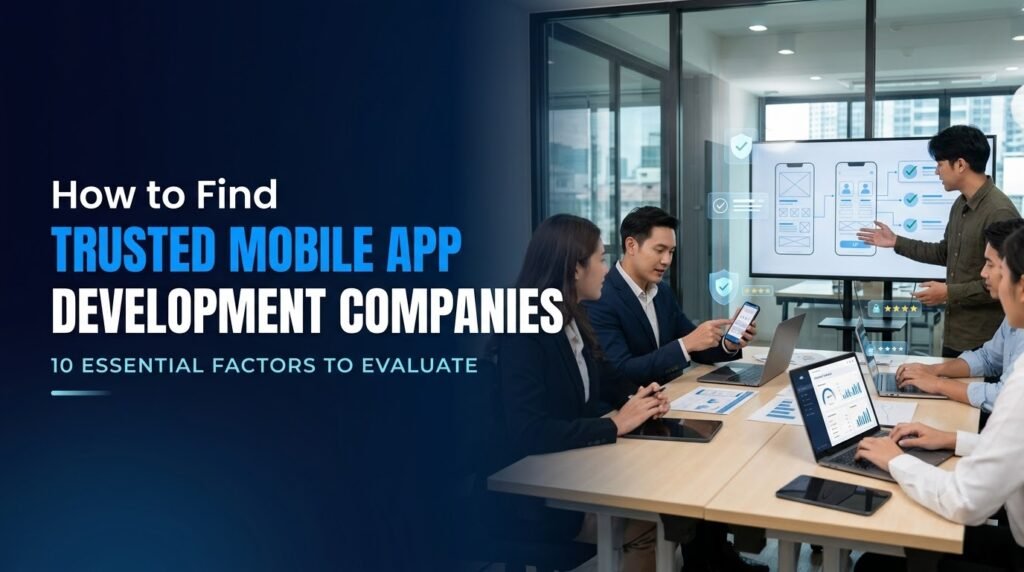




Choosing a mobile app development partner is an important business decision. The right team can help transform an idea into a secure, functional, and scalable application, while the wrong choice can lead to missed deadlines, unexpected costs, technical problems, and expensive redevelopment. Researching Trusted mobile app development companies carefully helps s tartups, small businesses, and established organisations make informed decisions before investing in a project.
A professional website, a low quotation, or a collection of positive testimonials is not enough to establish credibility. Businesses should examine previous projects, technical expertise, development processes, communication standards, security practices, and long-term support arrangements. A reliable partner should also understand the commercial purpose of the app, not simply deliver the features listed in a specification.
This guide explains how to assess potential development partners, compare proposals, identify warning signs, and choose a company that aligns with your business objectives.
Why Choosing a Trusted App Development Partner Matters
Mobile applications often connect several business functions, including customer accounts, payments, inventory, booking systems, analytics, and third-party services. Their quality depends on decisions made throughout planning, design, development, testing, and maintenance.
Working with a trustworthy partner helps businesses establish realistic budgets, define project responsibilities, and identify technical risks early. It also supports better communication between stakeholders and developers.
A capable development team should be able to explain its technical decisions, document project requirements, test important user journeys, and plan for future improvements. These practices matter because an application that works for an initial launch may need additional capacity, integrations, and security updates as the business grows.
Trust should therefore be based on verifiable evidence, clear contractual commitments, and consistent professional behaviour rather than marketing promises alone.
10 Ways to Identify Trusted Mobile App Development Companies
1. Review Their Portfolio and Previous Projects
A portfolio offers an initial indication of a company’s experience, but the number of projects displayed is less important than their relevance and quality.
Look for applications with features or business requirements similar to yours. For example, a business developing a booking platform should investigate the company’s experience with scheduling, notifications, payments, user accounts, and backend integrations.
Whenever possible, inspect live applications in the Apple App Store or Google Play Store. Explore navigation, loading behaviour, accessibility, responsiveness, and the overall user experience. Ask the company to explain its role in each project, including which components it designed, developed, or maintained.
A detailed case study should clarify the original challenge, the solution delivered, and any measurable outcomes that can be substantiated.
2. Verify Client Reviews and Testimonials
Client feedback can help you understand how a company handles deadlines, communication, technical challenges, and changes in project scope.
Check independent review platforms, detailed case studies, professional profiles, and references supplied by the company. Read the actual comments rather than relying exclusively on star ratings.
Pay attention to repeated themes. Several clients independently mentioning clear communication or dependable maintenance may provide more useful information than a vague statement praising excellent service.
3. Evaluate Technical Expertise
The development approach should match your app’s functionality, performance requirements, budget, and future roadmap.
A potential partner should be able to explain its experience with:
-
Native iOS development using Swift and related Apple technologies.
-
Native Android development using Kotlin and the Android ecosystem.
-
Cross-platform frameworks such as Flutter and React Native.
-
Backend services, databases, APIs, cloud infrastructure, and third-party integrations.
-
Automated testing, deployment pipelines, monitoring, and performance optimisation.
Native development may be appropriate when an app needs deep platform integration or specialised device capabilities. Cross-platform development can be suitable when a business wants to share more code between iOS and Android.
Neither approach is automatically best. Ask developers to explain the trade-offs, expected maintenance requirements, and reasons for recommending a particular technology stack.
4. Check Industry and Business Understanding
Technical ability alone does not guarantee a useful application. Developers must understand the problem the app is intended to solve.
A retail business may prioritise product discovery and checkout, while a healthcare startup may need carefully controlled access to sensitive information. A logistics company may focus on location tracking, delivery updates, and integration with existing operational systems.
During initial discussions, assess whether the company asks about your target audience, competitors, revenue model, operational processes, and success criteria. A partner that challenges unclear assumptions and identifies missing requirements may help prevent unnecessary features and wasted expenditure.
5. Ask About Their Development Process
A structured development process makes progress easier to measure and problems easier to address.
A typical workflow includes discovery, requirement analysis, UI/UX design, technical planning, development, quality assurance, deployment, and post-launch maintenance.
Ask how the company organises these stages and what you will receive at each milestone. Useful practices include documented requirements, prioritised backlogs, sprint planning, demonstrations, test reports, and acceptance criteria.
For example, rather than approving an entire application only at the end, you could review an interactive prototype and then test working features in stages. This provides opportunities to correct misunderstandings before they become expensive changes.
6. Assess Communication and Project Transparency
Clear communication should begin before the contract is signed. You should know who manages the project, how often updates are provided, and where decisions and technical documentation are recorded.
Ask about response times, meeting schedules, progress reporting, escalation procedures, and the process for reporting delays. The company should be willing to explain risks honestly rather than repeatedly promising that everything is on track.
Transparent communication also means documenting decisions. When requirements change, both parties should understand the impact on cost, delivery dates, and existing functionality.
7. Compare Pricing and Project Proposals
The cheapest proposal may exclude essential work, while the most expensive proposal is not necessarily the strongest.
Request a written breakdown of the proposed scope, deliverables, estimated hours or phases, payment milestones, testing responsibilities, and deployment arrangements. Check whether the quote includes design, backend development, app-store submission assistance, documentation, and post-launch support.
Clarify possible additional expenses, such as cloud hosting, paid APIs, third-party licences, app-store accounts, and future enhancements.
Compare proposals on a like-for-like basis. If one quote includes security testing and maintenance while another covers only initial development, their headline prices are not directly comparable.
8. Confirm Security and Intellectual Property Ownership
Security should be addressed during architecture and development, not added as an afterthought.
Ask how the team protects sensitive data, manages authentication, secures APIs, limits access, handles dependencies, and responds to vulnerabilities. For projects involving personal or regulated information, discuss applicable privacy obligations and the evidence needed to demonstrate compliance.
Ownership requires equal attention. The contract should define rights to source code, designs, documentation, and project-specific deliverables. Confirm who controls the source-code repository, hosting accounts, signing credentials, and other essential project assets. Include confidentiality and third-party licensing terms where appropriate.
9. Understand Post-Launch Support
Launching an app is the beginning of its operational life, not the end of the project.
Operating system updates, device changes, new security vulnerabilities, user feedback, and business requirements may all require ongoing work. Ask what support is available after release and whether it covers bug fixes, performance monitoring, compatibility updates, backups, and new features.
Distinguish a warranty from a maintenance agreement. A warranty generally covers specified defects within an agreed period, whereas ongoing maintenance may involve continuing monitoring, updates, and separately priced development work.
Confirm response times, support hours, service exclusions, and pricing before signing.
10. Request References and Validate Their Claims
Speaking with a previous client can reveal details that a portfolio cannot. Request references from projects with comparable complexity, integrations, or business requirements.
Ask clients whether the company met its commitments, communicated problems promptly, handled changes fairly, and provided adequate documentation. Find out whether the delivered application required significant unplanned work after launch.
You should also verify relevant claims about team experience, certifications, partnerships, and project results. Where a certification or qualification matters to your project, confirm its scope and current validity rather than relying on a logo displayed on a website.
A trustworthy company should be comfortable explaining its capabilities and acknowledging the limits of its experience.
How to Choose an App Development Company for Your Project
Understanding How to choose an app development company becomes easier when you follow a consistent evaluation process instead of making a decision based on a sales presentation.
-
Define your objectives: Identify the problem the app will solve, its target audience, essential features, and expected business outcomes.
-
Establish a budget and timeline: Set realistic financial limits and identify any important launch dates or external dependencies.
-
Create a shortlist: Prioritise companies with relevant portfolio examples, suitable technical skills, and experience working with businesses of a similar scale.
-
Verify their credibility: Examine independent reviews, live applications, case studies, and client references.
-
Request detailed proposals: Ask shortlisted candidates to explain scope, deliverables, technology choices, assumptions, costs, and exclusions.
-
Conduct discovery discussions: Use meetings to assess how well the team understands your business and responds to technical questions.
-
Compare the complete offering: Evaluate communication, security, testing, ownership, maintenance, and overall project value.
-
Finalise the contract: Document milestones, acceptance criteria, payment terms, confidentiality, intellectual property rights, and exit arrangements.
Before making a final decision, ensure the people responsible for delivery understand the agreed scope. A polished proposal is of limited value if the actual development team cannot explain how it will implement the solution.
Red Flags to Watch Out for When Hiring an App Development Company
Even an attractive proposal can conceal risks. Watch for warning signs such as:
-
Guaranteed success: No development company can guarantee commercial success without knowing how customers will respond to the finished product.
-
Unrealistic prices or deadlines: Ask for a breakdown of assumptions when an estimate appears unusually low or a complex app is promised exceptionally quickly.
-
Vague contracts: Avoid agreements that do not clearly define deliverables, exclusions, milestones, and acceptance criteria.
-
Unverifiable portfolio claims: Request live links, demonstrations, or references to establish the company’s actual contribution.
-
Poor pre-contract communication: Repeatedly missed meetings or unclear answers may indicate problems with project management.
-
Weak security and testing plans: Ask for concrete testing procedures, security responsibilities, and defect-resolution processes.
-
Unclear ownership: Confirm that the agreement explains access to source code, project assets, and intellectual property.
-
Missing support arrangements: Establish who will resolve production issues and maintain the application after launch.
Investigate concerns directly. Request written clarification, speak with references, and have a qualified professional review the contract if the project involves substantial investment or sensitive data. If important questions remain unanswered, consider another provider.
Trusted App Development Agencies vs. Freelancers
Both agencies and independent freelancers can deliver excellent work. The right option depends on the app’s complexity, available budget, and level of support required.
| Factor | Development agency | Independent freelancer |
|---|---|---|
| Team capacity | May offer designers, developers, testers, and project managers | Usually one primary professional, with specialist support depending on arrangements |
| Cost structure | May involve higher overheads and broader service packages | Can be more economical for clearly defined projects |
| Specialisation | May provide several technical disciplines under one engagement | Expertise depends on the individual’s skills and network |
| Communication | Often follows a defined project management process | May offer direct communication with the developer |
| Accountability | Responsibilities can be distributed across a team and contract | Often rests primarily with the individual |
| Long-term support | May offer structured maintenance plans | Depends on availability and the support agreement |
For a simple prototype or limited feature update, a freelancer may be sufficient. A complex application involving multiple platforms, backend integrations, security requirements, and ongoing releases may benefit from a multidisciplinary team.
When comparing Trusted app development agencies, look beyond the size of the organisation. Establish who will actually perform the work, how specialists are allocated, and what happens if a key team member becomes unavailable.
Questions to Ask Before Hiring a Mobile App Development Company
Use these questions during discovery calls or proposal reviews to assess whether a potential partner can meet your requirements.
-
Have you completed projects similar to mine, and can I review them?
-
Who will work on my project, and who will manage delivery?
-
How do you estimate development costs and delivery timelines?
-
How will you report progress and communicate scope changes?
-
What testing methods and security practices do you follow?
-
Who will own the source code, designs, and intellectual property?
-
What support and maintenance options are available after launch?
-
How do you handle delays, technical risks, and changes in requirements?
Pay attention to the quality of the answers. A capable partner should explain its approach in understandable language, identify relevant trade-offs, and acknowledge uncertainties. Detailed, realistic answers are more valuable than confident promises unsupported by a clear plan.
Why Businesses Should Look for Reliable Mobile App Development Companies
Choosing Reliable mobile app development companies means looking for consistent delivery practices rather than expecting a completely risk-free project.
Dependable partners establish clear responsibilities, document technical decisions, test functionality, and communicate issues before they become major obstacles. They also understand that an app must remain useful and maintainable after its first release.
For businesses, these qualities can make budgeting more predictable, simplify collaboration, and reduce the risk of becoming dependent on undocumented systems or inaccessible project assets.
Assess reliability across the complete relationship: discovery, development, testing, launch, and ongoing support. A company that demonstrates transparency throughout these stages is generally easier to evaluate and manage than one that focuses exclusively on its initial sales pitch.
How Ambient Infotech Can Help With Mobile App Development
Businesses researching development partners can also explore Ambient Infotech’s mobile app development services.
Ambient Infotech’s official service page describes mobile application development for Android and iOS, along with capabilities involving AI/ML, API and third-party integrations, authentication, cloud data synchronisation, and application performance. These capabilities may be relevant to businesses planning a new application or extending an existing digital product.
Before engaging any provider, including Ambient Infotech, discuss the intended users, essential features, preferred platforms, integrations, budget, delivery expectations, security requirements, and future maintenance needs. Ask for a proposal that explains the recommended approach and clearly identifies what is included.
You can review the official Ambient Infotech website and use its contact page to enquire about your project.
The most useful next step is to compare the proposed solution against your requirements, verify relevant experience, and agree on measurable deliverables before development begins.
Conclusion
Finding Trusted mobile app development companies requires more than comparing prices or reviewing impressive portfolios. Businesses should evaluate technical expertise, relevant experience, client feedback, communication, development processes, security practices, intellectual property ownership, and post-launch support before selecting a partner.
A structured selection process helps you identify potential risks, compare proposals fairly, and establish clear expectations from the beginning. Whether you choose an agency or an independent developer, prioritise evidence, transparency, and a practical understanding of your business objectives.
Take the time to verify important claims, ask detailed questions, and review contractual commitments before investing. The right development partner should be able to explain not only how your app will be built, but also how it will be tested, maintained, and improved as your business evolves.