




Introduction
Mobile applications have become an important part of how businesses serve customers, manage operations, and introduce new products. From online shopping and digital banking to healthcare services and employee management, applications help organizations deliver convenient, connected experiences. Emerging app development companies are contributing to this transformation by adopting modern technologies, developing customer-focused solutions, and helping businesses turn ideas into practical digital products.
As customer expectations evolve, organizations need applications that are secure, accessible, easy to use, and capable of adapting to changing requirements. Technologies such as artificial intelligence (AI), cross-platform frameworks, cloud computing, and automation are expanding what businesses can achieve through software.
However, adopting new technology is not enough. Successful applications also require clear business objectives, thoughtful design, reliable engineering, and ongoing maintenance. Understanding these factors can help organizations choose the right development partner and make informed technology investments.
What Are Emerging App Development Companies?
Emerging app development companies are growing or relatively new software development providers that build mobile applications, web applications, and other digital products using modern development practices and technologies.
They may specialize in particular industries, application types, or technical capabilities. Some focus on startup MVPs, while others help established organizations modernize legacy applications or introduce new digital services.
Common characteristics include:
- Modern development frameworks: Using technologies such as Flutter and React Native where appropriate.
- Flexible collaboration: Adapting development priorities as project requirements evolve.
- User-focused design: Building interfaces around customer needs and usability.
- Specialized expertise: Concentrating on areas such as e-commerce, healthcare, AI, or business automation.
- Scalable architecture: Planning applications to accommodate future users, features, and integrations.
- Continuous improvement: Using testing, analytics, and feedback to refine products over time.
A company’s age or size does not automatically determine its capabilities. Businesses should evaluate technical competence, delivery processes, security practices, financial stability, and support arrangements before selecting a development partner.
How Emerging App Development Companies Are Transforming the Digital Landscape
1. Accelerating Digital Transformation
Application development helps businesses replace disconnected processes with more accessible and integrated digital workflows. Instead of relying entirely on spreadsheets, paper forms, or manual communication, organizations can use applications to coordinate activities and improve access to information.
For example, retailers can provide digital catalogues, order tracking, and customer loyalty features. Educational institutions can offer online learning and student portals. Healthcare providers may use appointment scheduling and patient communication applications, while logistics businesses can improve shipment visibility and delivery coordination.
Financial service providers can also use applications to make account information and customer support more accessible, subject to applicable security and regulatory requirements.
The right solution depends on the problem being addressed. Emerging app development companies can help organizations identify suitable features, prioritize implementation, and connect new applications with existing systems.
2. Making Artificial Intelligence More Accessible
AI is creating opportunities to make applications more responsive, personalized, and efficient. Businesses can integrate selected AI capabilities without necessarily building an entire product around artificial intelligence.
Practical applications include:
- Personalized product and content recommendations.
- Conversational assistants for common customer questions.
- Intelligent search across products or business documents.
- Automated classification and processing of routine requests.
- Predictive insights that support planning and decision-making.
For example, an e-commerce application might recommend products based on relevant customer preferences, while an internal business app could help employees locate information more quickly.
AI implementation requires careful planning. Businesses should consider data quality, privacy, model reliability, operating costs, and the consequences of inaccurate outputs. Human review is especially important for sensitive or high-impact decisions. AI should be introduced when it solves a meaningful problem, not simply because it is a popular technology.
3. Expanding Cross-Platform Development
Cross-platform frameworks allow developers to share portions of an application’s code across multiple operating systems. Technologies such as Flutter and React Native can help businesses develop applications for Android and iOS while reducing duplicated work in suitable projects.
Potential benefits include more consistent product experiences, shared business logic, and simplified maintenance. These advantages can be valuable for startups and organizations working within limited budgets.
However, cross-platform development does not eliminate every platform-specific requirement. Device integrations, advanced graphics, operating-system features, performance-sensitive functions, and platform conventions may require additional implementation and testing.
Businesses should select a framework based on their functional requirements, development team’s expertise, performance expectations, and long-term maintenance plans.
4. Improving User Experience Through Modern UI/UX Design
A feature-rich application can still fail to meet business objectives if users find it confusing or difficult to navigate. User interface (UI) and user experience (UX) design help make digital products more understandable and accessible.
Effective design practices include:
- Clear navigation and consistent interface patterns.
- Responsive layouts for different screen sizes.
- Accessible text, controls, and interaction methods.
- Useful onboarding and contextual guidance.
- Usability testing with representative users.
- Improvements based on customer feedback.
For example, a delivery application should make it easy to place an order, track progress, and contact support. Reducing unnecessary steps can improve the experience without adding complicated features.
Emerging app development companies can incorporate design reviews and user testing throughout development, helping teams identify usability issues before they become expensive to fix.
5. Supporting Cloud-Based and Scalable Applications
Cloud services, application programming interfaces (APIs), databases, and backend systems allow applications to exchange information and support business operations.
A cloud-connected application might synchronize customer records across devices, integrate with a payment provider, or provide real-time inventory information to employees.
Scalable architecture helps applications accommodate changing workloads and future functionality. Businesses should consider expected traffic, database performance, backup arrangements, monitoring, integration requirements, and cloud expenditure.
Cloud adoption does not automatically guarantee lower costs or better reliability. The architecture must be appropriate for the workload, and security configurations, resource usage, and operational responsibilities require ongoing attention.
6. Strengthening Application Security
Security should be considered throughout the application lifecycle rather than addressed only before launch. Emerging app development companies need to account for data protection, secure coding, authentication, authorization, and third-party dependencies.
Important practices include:
- Protecting sensitive information in transit and at rest where appropriate.
- Applying least-privilege access controls.
- Keeping frameworks, libraries, and dependencies updated.
- Testing APIs and application components for vulnerabilities.
- Using secure secrets management and appropriate logging.
- Maintaining backups and an incident response process.
Applications handling financial, healthcare, or personal information may also face additional legal and industry-specific requirements.
Businesses can consult the Mobile Application for guidance on assessing mobile application security. Security requirements should be documented, tested, and reviewed as the product evolves.
7. Enabling Faster Innovation Through Agile Development
Agile development emphasizes incremental delivery, collaboration, and regular feedback. Rather than attempting to build every planned feature before releasing anything, a team can develop a smaller, useful version of the product and improve it through successive iterations.
A minimum viable product (MVP) typically includes the core functionality needed to test important assumptions with real users.
For example, a startup developing a booking platform might initially prioritize account creation, service listings, scheduling, and booking confirmation. Advanced analytics and additional integrations can follow once the initial experience has been evaluated.
Prototypes, sprint reviews, automated testing, and feedback sessions help teams identify problems early. Nevertheless, development speed depends on scope, technical complexity, team capacity, and external dependencies. Agile practices improve adaptability; they do not guarantee a fixed delivery date.
Emerging Technologies Influencing the Future of App Development
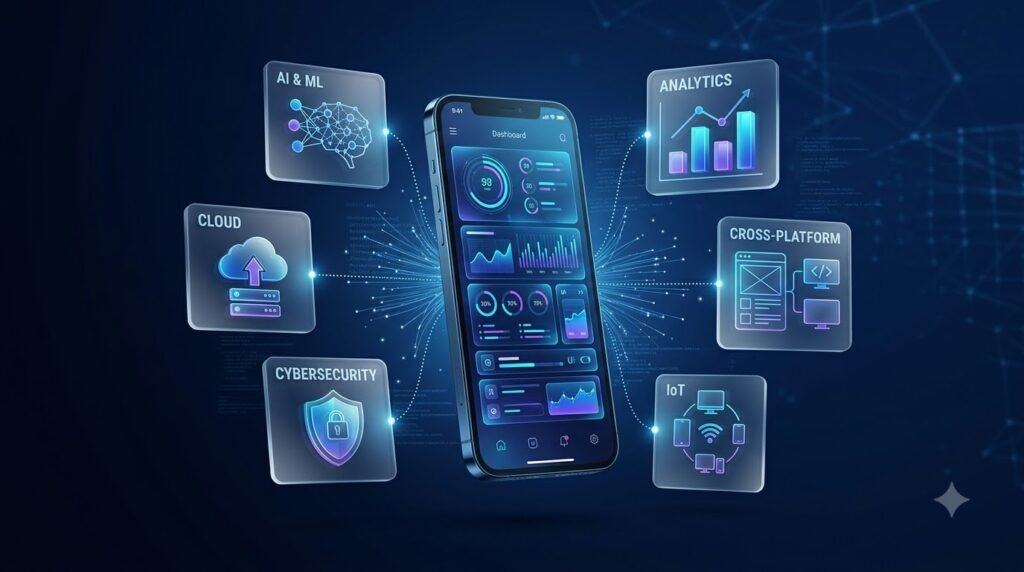
Several technologies are expanding application capabilities, but their value depends on business needs and implementation quality.
| Technology | Potential business applications | Key consideration |
|---|---|---|
| AI and machine learning | Recommendations, search, prediction, and assistance | Data quality, privacy, accuracy, and cost |
| Internet of Things (IoT) | Connected equipment, sensors, and asset monitoring | Device compatibility and secure connectivity |
| Augmented and virtual reality (AR/VR) | Product visualization, training, and immersive experiences | Hardware access, usability, and development cost |
| Cloud-native and serverless computing | Flexible infrastructure and event-driven services | Cost monitoring, reliability, and vendor dependency |
| Low-code and no-code platforms | Internal tools, forms, and simple workflow automation | Customization limits, governance, and integration |
| Automation and analytics | Reporting, repetitive tasks, and operational insights | Data consistency and process design |
| Wearables and connected devices | Fitness tracking, notifications, and remote monitoring | Battery constraints, privacy, and device-specific testing |
AI may help personalize customer interactions, while IoT can connect physical assets with digital systems. AR can help shoppers visualize products, and cloud-native services can support applications with variable workloads.
Low-code platforms may be appropriate for simple internal workflows, but highly customized products may require conventional software engineering. Similarly, wearables can support specialized experiences, although battery life, device compatibility, and privacy must be addressed.
Businesses should assess expected value, implementation effort, security, and maintenance obligations before committing to an emerging technology.
Benefits of Working With an Emerging App Development Company
The right development partner can offer several advantages, depending on its team structure and experience.
- Flexible collaboration: Smaller or specialized teams may provide direct access to developers and decision-makers.
- Focused expertise: A company with relevant technical experience may be well suited to a particular product or industry.
- Tailored solutions: Custom development can align functionality with specific operational requirements.
- Adaptability: Iterative workflows can help teams respond to changing priorities.
- Efficient coordination: Clear communication channels may reduce delays in gathering feedback and resolving questions.
These benefits are not exclusive to emerging providers, and they are not guaranteed. Some companies may have limited capacity, less mature delivery processes, or insufficient experience supporting complex applications over several years.
Before entering an agreement, businesses should examine staffing continuity, financial stability, project documentation, quality assurance, and post-launch support. The objective is to find a partner whose capabilities match the project’s actual requirements.
Challenges Emerging App Development Companies Must Overcome
Emerging providers must establish credibility while competing with more established firms. A limited portfolio can make it difficult to demonstrate experience with large-scale projects, complex integrations, or demanding compliance requirements.
They may also face challenges recruiting experienced developers, maintaining consistent code quality, controlling project costs, and supporting applications as teams grow.
These challenges can be addressed through structured engineering practices, documented development standards, code reviews, automated testing, transparent project reporting, and ongoing technical training.
Companies should also establish realistic project plans and define post-launch responsibilities before development begins. Clear contracts, documented requirements, contingency planning, and knowledge transfer help reduce the risks associated with changing team members or expanding project scope.
How Businesses Can Choose the Right Emerging App Development Company
Selecting a development partner requires more than comparing prices or reviewing a polished portfolio. Businesses should evaluate the provider’s ability to deliver, secure, and maintain a solution that meets defined objectives.
Review Technical Expertise
Confirm experience with the relevant frameworks, programming languages, APIs, databases, cloud environments, and third-party integrations. Ask how the proposed architecture will support the required features and future changes.
Examine Portfolios and Case Studies
Review live applications, technical complexity, and relevant industry experience. Ask for verifiable examples of completed work and distinguish documented outcomes from marketing claims.
Evaluate Communication and Project Management
Understand how requirements are documented, milestones are tracked, feedback is handled, and risks are escalated. Regular progress updates and clear ownership of decisions are essential.
Compare Proposals and Pricing
Compare scope, deliverables, timelines, payment milestones, assumptions, third-party charges, and change-request procedures. The lowest initial quote may not represent the lowest total cost of ownership.
Confirm Security and Ownership
Clarify source-code ownership, intellectual property rights, data access, confidentiality, security testing, and responsibility for third-party components. Make sure the contract specifies who owns and controls project assets.
Assess Long-Term Support
Ask about bug fixes, operating-system compatibility, dependency updates, monitoring, backups, security patches, and future enhancements. Confirm response times and support costs in writing.
Pre-contract checklist
-
Technical skills match the project requirements.
-
Portfolio claims and references have been verified.
-
Scope, milestones, and deliverables are documented.
-
Security and data protection responsibilities are defined.
-
Source-code and intellectual property ownership are clear.
-
Pricing includes relevant third-party and maintenance costs.
-
Post-launch support and knowledge transfer are agreed upon.
The Role of Emerging App Development Companies in Business Growth
Well-planned applications can support business growth by making services easier to access, improving customer engagement, and connecting information across departments.
A customer-facing app may simplify purchases or bookings, while an internal application can reduce repetitive data entry and improve access to operational information. Integrations with CRM, ERP, inventory, or payment systems can also help reduce fragmented workflows.
Digital products may create opportunities for subscription services, online marketplaces, and new customer experiences. Analytics can help businesses understand how customers use features and where improvements are needed.
However, technology alone does not guarantee growth. Results depend on market demand, product positioning, usability, execution, customer support, and continued investment. Businesses should define measurable objectives—such as reduced processing time, improved task completion, or increased customer retention—and evaluate performance after launch.
What the Future Holds for App Development Companies
The future of mobile app development will likely involve continued experimentation with AI-assisted features, cross-platform frameworks, connected devices, and cloud-based services. Privacy, accessibility, security, and maintainability are also likely to remain important priorities.
Businesses may increasingly seek applications tailored to specific industries and workflows instead of adopting generic solutions that do not fit their operations. Development teams may use more automation for testing and delivery while maintaining human oversight for important technical and product decisions.
These developments are possibilities rather than guaranteed outcomes. Technologies will continue to evolve, and their adoption will depend on cost, user expectations, regulation, and practical business value.
For businesses, a future-ready application is not necessarily the one with the most advanced technology. It is one that solves a meaningful problem, protects users, integrates with essential systems, and can be maintained as requirements change.
How Ambient Infotech Fits Into the Evolving App Development Landscape
Ambient Infotech provides web and mobile app development services for businesses looking to build digital products and modernize their operations. Its published service information describes mobile application development for Android and iOS, cross-platform development using Flutter and React Native, AI-powered application capabilities, and MVP development. These offerings can be evaluated against a project’s specific technical and commercial requirements.
The company also presents services covering web development, e-commerce, software development, and related digital solutions. Businesses considering a partnership should review the relevant service details, discuss project requirements directly, and clarify scope, security arrangements, deliverables, ownership, and ongoing support before making a decision.
Explore the Ambient Infotech mobile app development or visit the Ambient Infotech to learn more.
The most suitable development partner is one that understands the business problem, recommends an appropriate technical approach, communicates transparently, and plans for the application’s long-term success.
Conclusion
Emerging app development companies are contributing to digital transformation through modern frameworks, AI-enabled functionality, scalable architecture, user-focused design, and iterative development practices. They can help startups validate ideas and enable established organizations to improve digital services and operational workflows.
Choosing the right partner requires careful evaluation of technical expertise, communication, security, project management, ownership, and long-term support. Businesses should also consider the total cost of building and maintaining an application rather than focusing only on initial development expenses.
For organizations planning their next digital product, the best starting point is a clearly defined business problem and a practical understanding of user needs. Prioritize solutions that deliver measurable value, remain secure and maintainable, and can evolve with the business—rather than adopting technology simply because it is new.