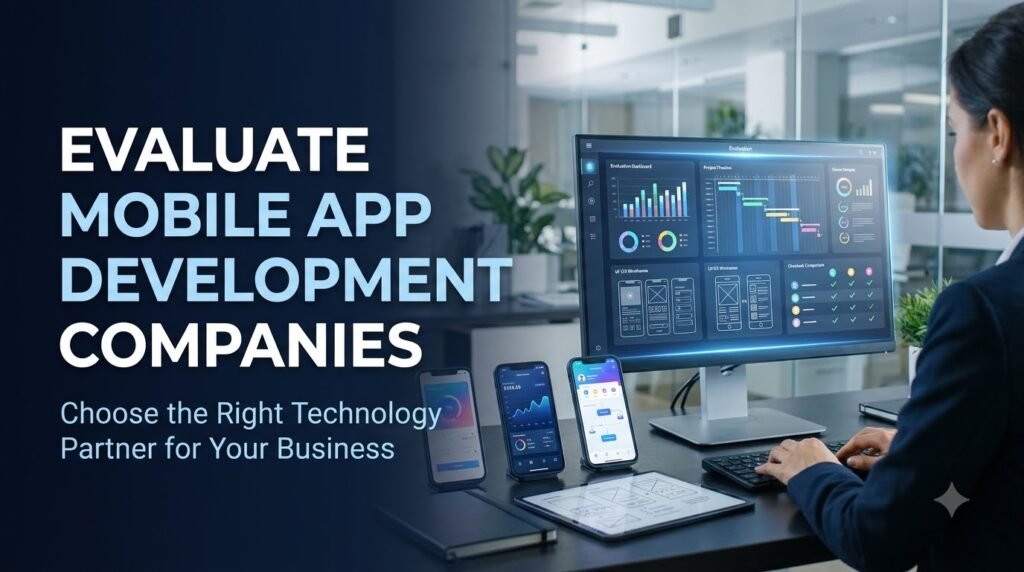




Choosing a mobile application development partner is an important business decision. The company you hire can influence your application’s performance, usability, security, development budget, launch schedule, and ability to accommodate future growth. A visually attractive app may create a strong first impression, but its long-term value depends on how effectively it solves a real problem for users.
Understanding how to evaluate mobile app development companies helps businesses make informed decisions instead of relying solely on attractive portfolios, sales presentations, or low quotations. Whether you are a startup building your first minimum viable product (MVP), a small business digitising its services, or an established organisation modernising an existing application, you need a development partner whose capabilities align with your objectives.
The right choice is not necessarily the cheapest or most popular provider. It is the company that understands your requirements, recommends appropriate technologies, communicates clearly, follows a structured development process, and offers a realistic plan for ongoing support.
This guide explains the practical criteria you should use to assess potential providers, compare proposals, identify warning signs, and choose a technology partner that fits your business needs.
Why Choosing the Right App Development Company Matters
Mobile applications often become an important part of how businesses serve customers, manage operations, and deliver products or services. Their quality depends on more than writing code. Design decisions, system architecture, testing, security, and maintenance all contribute to the final result.
Working with an unsuitable provider can lead to missed deadlines, unexpected expenses, poor usability, technical limitations, or an application that becomes difficult to maintain. In some cases, businesses must pay another development team to correct avoidable problems.
A capable partner helps reduce these risks by translating business objectives into a workable technical plan.
Consider five important areas:
-
Application performance: Efficient code and suitable architecture help an app respond reliably under expected workloads.
-
User experience: Clear navigation and thoughtful interface design make essential tasks easier for customers.
-
Budget and timelines: Defined deliverables, realistic estimates, and controlled scope changes improve financial planning.
-
Security and privacy: Appropriate access controls, encryption, and secure data handling help protect sensitive information.
-
Long-term scalability: Maintainable code and well-planned integrations make future improvements easier to implement.
These factors explain why mobile app development company selection should involve a structured evaluation rather than a quick comparison of prices.
1. Define Your Business Goals and App Requirements
Before contacting developers, establish what the application needs to accomplish. Without clear requirements, it becomes difficult to compare proposals because different companies may interpret the same idea in very different ways.
Start by identifying the business problem. Are you trying to simplify bookings, enable online purchases, improve employee productivity, manage customer relationships, or introduce a new digital service? Define the intended outcome before discussing individual features.
Next, document the following:
-
Target audience and the tasks users need to complete.
-
Essential features, such as registration, payments, notifications, bookings, or reporting.
-
Required platforms, including Android, iOS, or both.
-
Backend functionality, databases, APIs, and third-party integrations.
-
Expected launch date and available development budget.
-
Privacy, accessibility, performance, and regulatory requirements relevant to your business.
Separate essential launch features from enhancements that can be introduced later.
For example, a startup developing a booking application may initially require account registration, service listings, appointment scheduling, payment processing, and booking confirmations. Advanced loyalty programmes and predictive recommendations could be introduced after the core experience has been tested with users.
This prioritisation helps providers estimate the first release more accurately. It also makes proposals easier to compare because each company is responding to the same scope.
A clear requirements document is therefore one of the most useful tools when assessing mobile app development services.
2. Review Technical Expertise and Development Capabilities
A development company should demonstrate technical knowledge that matches your application’s complexity. Do not assume that expertise in website development automatically means a provider has the right experience for every mobile application.
Ask prospective partners to explain their recommended technology stack and the reasons behind their choices.
Native versus cross-platform development
Native Android and iOS development may be appropriate when an application requires platform-specific functionality, specialised device capabilities, or highly customised performance.
Cross-platform frameworks such as Flutter and React Native can allow businesses to build applications for multiple platforms using a shared codebase. Depending on the project, this approach may reduce duplicated development work and simplify certain maintenance tasks.
Neither approach is universally superior. The decision should account for application requirements, team expertise, performance expectations, integration needs, and long-term maintenance.
Backend and integration capabilities
Many mobile applications rely on services beyond the interface users see. These may include authentication systems, payment gateways, cloud infrastructure, databases, analytics, or connections to existing CRM and ERP platforms.
Ask whether the company can design and maintain these components or whether additional providers will be involved.
Testing and maintainability
A technically capable team should explain how it handles code reviews, automated testing, compatibility checks, performance optimisation, and defect resolution. Ask how the codebase will be documented and maintained after the original developers move on.
Assessing mobile app developer experience means understanding not just which tools a team knows, but whether it can apply them appropriately to your particular requirements.
3. Examine the Portfolio and Relevant Project Experience
A company’s portfolio provides evidence of the types of applications it has worked on, but screenshots alone cannot establish whether its development capabilities match your needs.
When reviewing a mobile app development portfolio, look beyond visual appearance. Examine the functionality, navigation, responsiveness, and complexity of the applications presented.
Ask potential providers to explain:
-
Whether they have developed applications with business models similar to yours.
-
Which features and integrations were particularly challenging.
-
What responsibilities their team handled, including design, backend development, testing, and deployment.
-
How they approached performance, usability, and maintenance.
-
Whether they can demonstrate relevant projects or provide detailed case studies.
Where possible, test publicly available applications yourself. Try registering an account, completing a purchase, booking a service, or using other features relevant to your project.
It is also important to establish the company’s exact contribution. A provider may have worked on one component of a larger product rather than delivering the entire application. This does not necessarily make its work less valuable, but you should understand what experience it can genuinely demonstrate.
Industry knowledge can be useful, particularly when your application involves complex workflows. For example, a healthcare application may require different privacy considerations and integrations from a retail shopping app.
The goal is to identify evidence of relevant problem-solving ability, not simply to find a portfolio with attractive designs.
4. Check Client Reviews, Testimonials, and Reputation
Reviews can help you understand what working with a development company may be like. However, ratings should be treated as one part of your evaluation rather than definitive proof of quality.
When assessing mobile app development company reviews, look for detailed feedback on project delivery, communication, technical problem-solving, budget management, and post-launch assistance.
Independent business directories, professional review platforms, verified testimonials, and direct client references can provide useful perspectives. Give greater weight to feedback that describes a specific project, challenge, and outcome rather than vague praise.
Pay attention to recurring patterns. Several clients mentioning clear communication and dependable support may indicate a consistent strength. Repeated complaints about missed deadlines or unexpected charges deserve closer investigation.
If a company receives negative feedback, examine how it responds. A constructive explanation and willingness to address concerns can provide more information than a perfect-looking rating profile.
Before making a decision, consider asking for a reference from a client whose project was similar in size or complexity to yours. Ask whether the provider met agreed expectations and how it handled unexpected problems.
Independent verification is particularly valuable when a company makes claims about awards, certifications, customer numbers, or previous results. Request supporting evidence instead of relying on promotional statements alone.
5. Evaluate the Development Process and Project Management
A well-defined development process gives you visibility into progress, responsibilities, risks, and important decisions. Without it, even a technically skilled team can struggle to deliver a project that meets expectations.
Ask each shortlisted company to explain its process from the initial discussion through release and ongoing maintenance.
A typical workflow may include:
-
Discovery and requirement analysis: Clarifying business goals, users, features, and constraints.
-
Planning and estimation: Defining milestones, responsibilities, dependencies, and delivery expectations.
-
UI/UX design: Developing user flows, wireframes, and interactive prototypes.
-
Development: Building the application and backend services, with appropriate code reviews.
-
Quality assurance: Testing functionality, compatibility, performance, and security.
-
Deployment: Preparing releases, completing store submissions where applicable, and checking production readiness.
-
Post-launch monitoring: Identifying defects, reviewing performance, and planning improvements.
Not every project follows precisely the same sequence. Agile approaches, for example, may involve delivering features in short iterations and gathering feedback throughout development.
What matters is that the company explains how decisions are made, how changes are approved, and how progress is measured.
Ask how frequently you will receive updates, whether you will have access to project management tools, and who will be responsible for resolving blockers. A transparent process helps you identify delays early and make informed decisions before problems become expensive.
6. Compare Pricing, Proposals, and Contract Terms
Comparing the mobile app development cost quoted by different providers requires more than placing their final prices side by side. Two proposals may have significantly different scopes, assumptions, testing provisions, and support arrangements.
Request a written breakdown covering the features, deliverables, technology choices, estimated timeline, and services included in the quotation.
Common pricing models include:
-
Fixed-price: Suitable when requirements and deliverables are clearly defined.
-
Time-and-materials: Charges are based on actual development time and agreed rates, offering flexibility when requirements may evolve.
-
Dedicated team: You engage a team or specific resources for an agreed period, which can suit continuing development or larger projects.
Check whether the proposal includes design, testing, deployment, documentation, and third-party integrations. Clarify recurring expenses such as cloud hosting, paid APIs, software licences, and app maintenance.
Contract terms deserve equal attention. Confirm payment milestones, procedures for scope changes, project cancellation conditions, intellectual property rights, and ownership of the source code.
Also establish what happens if a milestone is delayed or a requirement proves more complex than expected.
An unusually low quotation may omit essential work or rely on assumptions that later increase the total expense. Conversely, a high quotation does not automatically guarantee better engineering or service.
Compare each proposal against the same requirements and ask providers to explain any major differences. The objective is to understand the total expected investment and the value included, rather than simply choosing the lowest number.
7. Assess Communication, Transparency, and Team Compatibility
Communication affects nearly every stage of application development. A team may have excellent technical skills, but if it misunderstands your objectives or fails to communicate risks, the project can quickly move away from your expectations.
During initial discussions, observe how the company responds to your questions. Does it explain technical concepts clearly? Does it ask about your customers and business processes? Can it explain why a particular feature is necessary, or suggest a simpler alternative when appropriate?
A reliable partner should be willing to discuss limitations, dependencies, and trade-offs rather than promising that every request can be completed immediately.
Before signing an agreement, establish:
-
Who will manage day-to-day communication.
-
Whether a project manager or technical lead will be available.
-
How frequently progress reports and demonstrations will take place.
-
How urgent issues and important decisions will be escalated.
-
How your feedback will be documented and incorporated.
Time-zone differences, working hours, language preferences, and overlapping availability may also affect collaboration, particularly when working with an international team.
When choosing an app development partner, look for a working relationship in which both parties understand their responsibilities and can raise concerns openly. Clear communication makes it easier to manage expectations and address problems before they affect delivery.
8. Verify Security, Testing, and Quality Standards
Security and quality assurance should be part of the development plan from the beginning, not tasks left until the application is nearly ready to launch.
Start by understanding what information the app will collect, process, or store. Personal details, payment information, business records, and location data may require different protections depending on their use and the applicable legal requirements.
Ask the development company how it plans to protect that information.
Important areas to discuss include:
-
Authentication and authorisation: Ensuring users can access only the features and information permitted for their roles.
-
Data protection: Using appropriate encryption and secure communication channels.
-
API security: Protecting connections between the application, backend systems, and third-party services.
-
Code quality: Reviewing code for defects, vulnerabilities, and maintainability concerns.
-
Functional testing: Checking that features behave as specified.
-
Compatibility testing: Verifying performance across relevant devices, screen sizes, and operating-system versions.
-
Performance testing: Evaluating response times and capacity under expected workloads.
-
Recovery planning: Establishing appropriate backups, recovery procedures, and incident-response responsibilities.
The testing plan should reflect the application’s risk level and complexity. An internal task-management app, for instance, may have different requirements from a financial services platform processing sensitive transactions.
Ask which tests will be performed, how defects will be prioritised, and what criteria must be met before release. If the provider claims to hold a particular security certification, request current evidence and clarify which organisation and services it covers.
A clear security and testing plan helps you evaluate whether the company can deliver an application that is suitable for its intended use.
9. Understand Post-Launch Support and Scalability
An application is not finished simply because it has been published. Operating-system updates, changes to third-party services, emerging security issues, and user feedback can all require further work.
Before hiring a provider, understand what happens after launch and whether the company can support the application over time.
Discuss the following areas:
-
Bug fixes and the duration of any included warranty.
-
Operating-system, framework, and dependency updates.
-
Ongoing security maintenance and vulnerability remediation.
-
Performance monitoring and troubleshooting.
-
New features, interface improvements, and integrations.
-
Backend, database, and infrastructure scaling.
-
Support availability, response times, and escalation procedures.
Ask whether maintenance is included in the original price or billed separately. If a service-level agreement applies, review its scope, exclusions, and measurable response commitments.
Scalability deserves attention as well. Your first release may serve a small user base, but future growth could introduce more transactions, data, integrations, or simultaneous users.
A suitable technical architecture should account for realistic growth without introducing unnecessary complexity or expense at the beginning.
Also clarify what happens if you eventually change providers. Access to source code, technical documentation, deployment configurations, and relevant credentials can help prevent avoidable dependency on a single development team.
Long-term support should be evaluated as carefully as initial delivery because it affects the application’s reliability and ongoing cost.
10. Questions to Ask Before Hiring a Mobile App Development Company
Use the following questions during discovery calls or proposal discussions. The answers can reveal whether a provider understands your requirements and has a practical plan for delivering the project.
-
Have you delivered projects with requirements similar to ours? Request relevant examples and clarify the team’s contribution.
-
Which technology stack do you recommend, and why? Look for reasoning based on your requirements rather than preference alone.
-
Who will work on our project? Understand the roles, experience, availability, and responsibilities of the proposed team.
-
How will you estimate the timeline and budget? Ask about assumptions, dependencies, milestones, and uncertainty.
-
How frequently will we receive progress updates? Establish a communication schedule and demonstration process.
-
How will scope changes be handled? Confirm the approval process and how changes affect cost and delivery dates.
-
Who will own the source code and intellectual property? Make ownership, licensing, and access rights explicit in the contract.
-
What testing procedures will you follow? Request details about functional, compatibility, security, and performance testing.
-
What happens if milestones are delayed? Ask how risks will be communicated and how revised plans will be agreed.
-
What maintenance and support options are available after launch? Clarify coverage, costs, response times, and responsibilities.
Strong answers should be specific and consistent with the written proposal. If important details remain unclear during the sales process, request clarification before committing.
How Ambient Infotech Can Support Your App Development Requirements
Businesses evaluating development providers can consider Ambient Infotech as one potential technology partner. The company’s official website describes its work in Android and iOS applications, cross-platform development, prototyping, MVP development, and custom mobile solutions. It also lists technologies including Flutter, React Native, Swift, and Kotlin.
These capabilities may be relevant to businesses planning a new application, validating an early-stage product, or developing an existing digital service further.
Before deciding whether Ambient Infotech fits your requirements, consider the following:
-
Project suitability: Discuss your target users, required features, business objectives, and preferred launch timeline.
-
Technology recommendations: Ask which development approach would suit your application and how the proposed architecture would support future changes.
-
Scope and budget: Request a written breakdown of deliverables, estimated costs, dependencies, and payment milestones.
-
Quality and security: Clarify testing procedures, data protection measures, and how technical issues will be resolved.
-
Ongoing support: Discuss maintenance arrangements, future enhancements, documentation, and ownership of the delivered code.
The company also lists AI-powered app development, integrations with third-party services, automated testing, and release-management capabilities on its mobile development page. Prospective clients should discuss which of these capabilities are applicable to their specific project and request relevant examples during the evaluation process.
You can explore the Ambient Infotech mobile app development or contact the team to discuss your requirements.
As with any provider, make your final decision after reviewing the proposal, team responsibilities, relevant work, contractual terms, and support arrangements. A direct discussion can help establish whether the company’s approach aligns with your expectations.
Conclusion
Evaluating development providers requires a balanced assessment of technical skills, business understanding, project experience, communication, pricing, security, and long-term support. No single factor can reliably predict whether a company will be the right fit for your application.
Understanding how to evaluate mobile app development companies begins with defining your requirements and continues through portfolio reviews, technical discussions, proposal comparisons, reference checks, and contract negotiations.
Before making a commitment, shortlist providers using consistent criteria, ask specific questions, and verify important claims. Make sure the agreement clearly explains deliverables, costs, ownership, testing, and post-launch responsibilities.
A thoughtful evaluation takes time, but it helps you select a partner based on evidence and project suitability rather than marketing promises alone.

