




Choosing a mobile app development company is a business decision that can influence product quality, customer experience, operational efficiency, and future growth. Whether you are a startup preparing to launch your first application, a small business digitising existing services, or an established organisation modernising its technology, the development partner you select will play an important role in turning your requirements into a working product.
However, comparing mobile app development companies involves more than reviewing portfolios, comparing quotations, or checking which technologies appear on a website. A polished presentation does not necessarily demonstrate strong engineering practices, and a low initial estimate may not account for testing, security, maintenance, or future enhancements.
A more reliable approach is to evaluate technical capability, project delivery standards, communication, security, and long-term support together. Businesses should also understand how a development team approaches problem-solving, manages changing requirements, and documents its work.
This guide explains how to assess Mobile app development technical expertise, evaluate completed projects, compare service offerings, and identify Reliable mobile app development partners that can support your business objectives. By following a consistent evaluation process, you can make a more informed decision based on evidence, practical requirements, and long-term value rather than sales promises alone.
Why Comparing Mobile App Development Companies Matters
A mobile application is not simply a collection of screens and features. It may connect to databases, payment systems, customer relationship management software, inventory platforms, external APIs, and other business services. Its performance depends on how these components work together.
The company responsible for developing the application can influence several important areas.
-
Application performance and usability: Efficient code, sensible architecture, and thoughtful interface design help create a smoother user experience.
-
Project timelines and budget control: Clear requirements, realistic milestones, and regular reviews help reduce avoidable delays and unexpected expenses.
-
Security and data protection: Appropriate authentication, access controls, secure data handling, and testing help reduce preventable vulnerabilities.
-
Scalability and future development: A maintainable technical foundation makes it easier to introduce new features as business requirements evolve.
-
Maintenance and long-term value: Documentation, monitoring, bug fixes, and planned updates help keep the application useful after launch.
Consider a business that wants to build a customer ordering application. One vendor may offer an attractive interface at a low price but provide limited information about payment integration, error handling, or maintenance. Another may present a more detailed plan covering backend reliability, testing, deployment, and future updates.
The second proposal may offer better long-term value, provided its approach and costs are justified. This is why businesses should compare the work included in each proposal rather than treating the lowest quotation as the best option.
A portfolio is useful, but it is only one part of the assessment. The development process, technical decisions, project scope, and support arrangements deserve equal attention.
Evaluate Mobile App Development Technical Expertise
Technical capability determines whether a development team can translate business requirements into a secure, functional, and maintainable application. Instead of relying exclusively on claims about expertise, ask the company to explain how it would approach your specific project.
Technology Stack and Platform Experience
The appropriate technology depends on the application’s purpose, expected usage, performance requirements, budget, and maintenance plans.
Native Android development commonly uses Kotlin, while native iOS development commonly uses Swift. Native development can be suitable when an application requires platform-specific functionality, specialised performance optimisation, or close integration with device capabilities.
Cross-platform frameworks such as Flutter and React Native can support applications for multiple platforms while allowing teams to share significant portions of their codebase. This approach may be appropriate when businesses want consistent experiences across Android and iOS without maintaining entirely separate implementations.
Neither approach is automatically better for every project. A capable provider should explain the trade-offs rather than recommend a framework simply because it is familiar with it.
Ask potential vendors:
-
Which technologies would you recommend for this application, and why?
-
Have you built applications with comparable functionality?
-
How will the chosen stack affect maintenance and future development?
-
What happens if the business needs to add another platform later?
-
Which technical dependencies could affect the project?
The quality of the reasoning behind a recommendation is often more informative than the number of technologies listed on a company website.
Architecture, APIs, and Backend Integration
An application may look simple on the screen while relying on a complex backend. User accounts, product catalogues, booking systems, payment processing, notifications, and reporting often require several components to communicate reliably.
When assessing Mobile app development technical expertise, examine how the provider approaches application architecture, database design, API integration, authentication, and error handling.
For example, an appointment-booking application may need to synchronise availability between its mobile interface and an existing business system. The development team should consider what happens when two users attempt to book the same time slot, a network connection fails, or an external service becomes unavailable.
Ask how the team will document integrations, manage sensitive credentials, handle failed requests, and test communication between systems. These discussions can reveal whether the vendor understands the operational requirements behind the interface.
Security, Performance, and Scalability
Security and performance should be considered during planning, not left until the application is ready to launch.
A sound development process may include secure authentication, role-based access controls, appropriate encryption, dependency management, input validation, and protection of sensitive information. The exact measures should reflect the application’s data, functionality, and applicable legal obligations.
Performance planning should cover loading times, network requests, resource consumption, and behaviour on supported devices. Scalability involves understanding how the architecture will respond if the number of users, transactions, or stored records increases.
No development company can eliminate every security risk or guarantee that an application will never experience performance problems. A credible provider should explain the controls it uses, the limitations of those controls, and how issues will be identified and addressed.
Practical technical evaluation checklist
-
Can the team explain its proposed architecture in plain language?
-
Does it have relevant experience with the required integrations?
-
How are authentication, authorisation, and sensitive data handled?
-
What performance and compatibility tests will be conducted?
-
How are technical risks documented and reviewed?
-
Will the business receive appropriate technical documentation?
Use these questions to assess evidence rather than accepting broad statements about technical excellence.
How to Assess Project Quality Before Hiring
Technical knowledge matters, but it must translate into a well-built application. Before signing a contract, investigate how the company defines quality, tests its work, and manages the complete development lifecycle.
Review Portfolio and Relevant Case Studies
Start by reviewing completed applications that resemble your proposed product in functionality, complexity, or business purpose. A company may have an impressive collection of visually attractive interfaces, but the more important question is whether its team has solved problems similar to yours.
Look for case studies that explain:
-
The original business problem and project objectives.
-
The application’s main features and integrations.
-
The development team’s responsibilities.
-
Technical challenges and how they were addressed.
-
The testing, deployment, and maintenance approach.
Distinguish between a project the company delivered itself and work in which it played a limited supporting role. If a case study presents performance improvements or business outcomes, ask how those results were measured and whether they can be verified.
When possible, request a demonstration of a completed application or access to a publicly available app-store listing. If the work is confidential, ask for an anonymised technical walkthrough or another permitted way to verify the team’s contribution.
A visually impressive portfolio can establish design capability, but it cannot independently confirm code quality, backend reliability, or security practices.
Check Code Quality and Testing Practices
Well-maintained code is easier to understand, test, troubleshoot, and extend. Poorly structured code may allow an application to launch initially but make later enhancements slower and more expensive.
Ask whether the development process includes code reviews, coding standards, version control, technical documentation, and automated testing where appropriate. Manual testing remains valuable for assessing workflows, usability, and scenarios that automated tests may not cover adequately.
A suitable quality assurance process should consider:
-
Functional testing to confirm that features behave as intended.
-
Integration testing to check communication between components.
-
Device and operating-system compatibility.
-
Performance and reliability under expected usage conditions.
-
Security testing appropriate to the application’s risk profile.
-
Regression testing to identify problems introduced by changes.
Also ask how bugs are recorded, prioritised, assigned, and resolved. A clear defect-management process helps both the client and development team understand what remains outstanding before release.
You do not necessarily need direct access to every line of source code during vendor selection. However, the provider should be able to explain its quality controls and agree on reasonable ways to demonstrate that those controls are followed.
Evaluate UI/UX and Accessibility
User interface design determines how an application looks, while user experience concerns how easily people can complete tasks. Both are essential to project quality.
Review whether the proposed design offers logical navigation, consistent layouts, readable text, clear feedback, and predictable interactions. Important actions such as completing a payment, submitting a booking, or updating an account should not require users to guess what happens next.
Accessibility deserves attention as well. Depending on the application, relevant considerations include screen-reader support, sufficient colour contrast, scalable text, touch-target sizes, and alternatives to interactions that rely only on colour or gestures.
Ask whether users will be involved in usability testing and how feedback will influence design revisions. A clickable prototype can help stakeholders review workflows before development costs increase.
A strong design process balances visual consistency with practical usability, platform conventions, accessibility, and the needs of the intended audience.
Review Delivery and Post-Launch Support
Launching an application is not the end of the project. Operating-system updates, changing third-party services, newly discovered bugs, and evolving business requirements can all require further work.
Confirm whether the proposal includes deployment preparation, app-store submission assistance, release documentation, monitoring, and a defined period for addressing launch-related defects.
Maintenance should be discussed separately from initial development. Ask what support is available, what it costs, which tasks are included, and how urgent issues will be handled.
The goal is to understand what happens after the initial delivery and avoid discovering later that essential support falls outside the original agreement.
Why Experienced mobile app developers Make a Difference
A development team’s value comes from its ability to make sound decisions, anticipate risks, and solve problems in the context of the business. Technical experience is useful when it helps the team recognise dependencies and choose an approach that fits the project’s real needs.
For example, a business may request a large set of features for its first application release. An experienced team can help assess which features are essential, which can wait, and which introduce unnecessary complexity. This can lead to a more manageable first release without losing sight of the longer-term product vision.
Capable developers also contribute to:
-
Identifying technical risks before they cause significant delays.
-
Working effectively with designers, backend engineers, and QA specialists.
-
Producing clear documentation and maintainable code.
-
Investigating difficult bugs and integration problems.
-
Adapting implementation plans when requirements change.
-
Explaining technical trade-offs to non-technical stakeholders.
However, years in the industry alone do not guarantee strong delivery. Relevant experience, practical reasoning, collaboration, and accountability are more meaningful indicators.
During vendor discussions, ask to meet the people who will actually work on your project. Clarify who will lead technical decisions, manage delivery, conduct testing, and communicate progress. Ask candidates to explain how they would handle a realistic challenge from your project brief.
Their answers should demonstrate a structured problem-solving approach rather than vague assurances that every requirement can be completed easily.
Compare Custom mobile app development services
Businesses with specific operational needs may require an application tailored to their workflows, customer journeys, or existing software. In these situations, Custom mobile app development services should cover more than writing code to match a feature list.
Assess the Discovery and Planning Process
Before development begins, the provider should work with stakeholders to understand business objectives, target users, functional requirements, technical constraints, and measures of success.
This discovery stage helps identify missing requirements and conflicting expectations before they affect cost or delivery.
Ask how the company converts business needs into a project specification, user journeys, technical architecture, and prioritised backlog. You should also understand which assumptions still need validation.
Review MVP Planning and Feature Prioritisation
A minimum viable product (MVP) is an initial version designed to test essential functionality and gather feedback without building every planned feature at once.
An MVP can be useful for startups and established businesses testing a new idea. The development partner should help identify the minimum set of features needed to address the main user problem, while avoiding shortcuts that compromise essential security or reliability.
The resulting roadmap should distinguish launch-critical functionality from improvements that can follow after user feedback.
Confirm Integrations, Ownership, and Deliverables
If the application must work with existing CRM, ERP, inventory, booking, payment, or analytics systems, confirm how those integrations will be handled and what access or third-party permissions are required.
The contract should also specify ownership of source code, design assets, documentation, and other project deliverables. Clarify whether any third-party libraries, licences, or proprietary components carry restrictions.
Before signing, make sure the statement of work identifies:
-
Included features and agreed deliverables.
-
Explicit exclusions and assumptions.
-
Milestones and approval responsibilities.
-
The process for handling scope changes.
-
Payment terms and any additional charges.
-
Source-code access and handover requirements.
-
Maintenance arrangements and future enhancement options.
A detailed agreement protects both parties by making expectations clear before work begins.
How to Identify Reliable mobile app development partners
A trustworthy development relationship depends on communication and accountability as much as technical ability. Even a capable team can struggle to deliver effectively if responsibilities, expectations, and decision-making processes remain unclear.
Evaluate each provider against the following considerations.
Communication and reporting: Establish who your primary contact will be, how often progress reports will be shared, and how quickly questions are normally addressed. Agree on a process for escalating urgent issues.
Pricing and timelines: Request an estimate that explains the scope, assumptions, dependencies, payment milestones, and potential additional costs. A fixed-price proposal should still explain how changes outside the agreed scope will be handled.
Project management: Understand how requirements, tasks, risks, approvals, and deadlines will be tracked. Regular demonstrations and milestone reviews can help identify misunderstandings before they become expensive problems.
Contracts and intellectual property: Review confidentiality terms, ownership rights, access permissions, warranties, termination conditions, and responsibilities for third-party services. Seek legal advice where the project’s complexity or risk warrants it.
References and verification: Where available, speak with previous clients or review verifiable feedback. Ask about communication, problem resolution, deadline management, and the quality of support after launch.
Maintenance commitments: Confirm the duration and scope of any warranty, available maintenance services, response-time commitments, and charges for ongoing work.
Be cautious of vendors that promise complex applications in implausibly short periods, provide estimates without understanding requirements, avoid discussing technical risks, or refuse to clarify ownership and handover arrangements.
A reliable partner does not need to claim that every project will run perfectly. It should demonstrate how risks are identified, communicated, and managed when circumstances change.
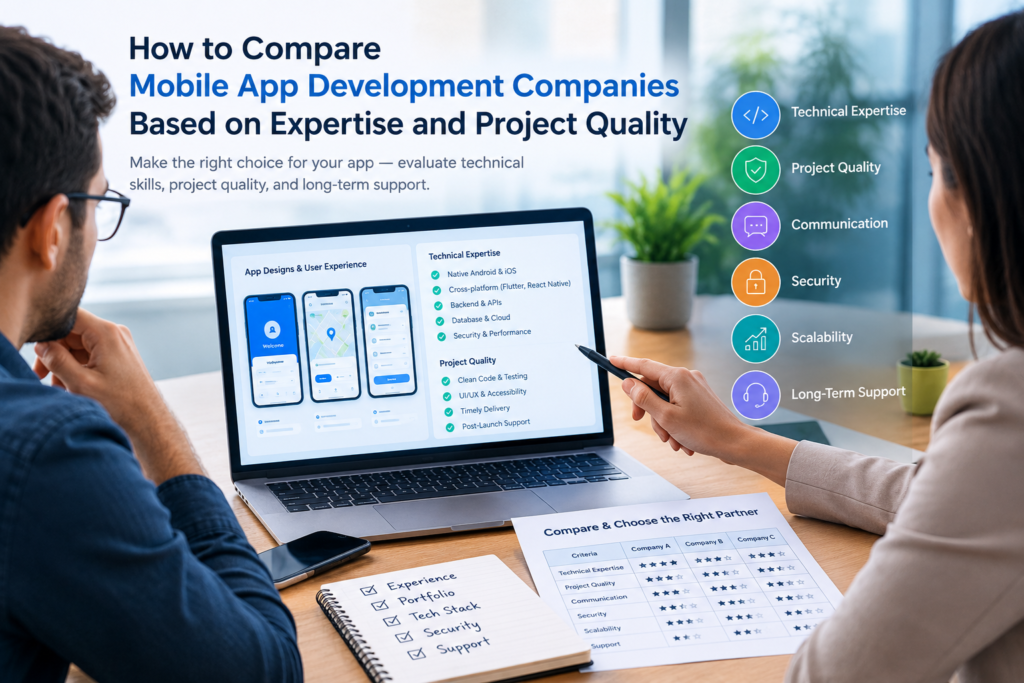
Compare Companies Using a Practical Evaluation Checklist
Once you have shortlisted a few vendors, use the same evaluation criteria for each company. This makes it easier to identify differences that may be hidden by polished presentations or differently structured quotations.
| Evaluation criterion | What to verify |
|---|---|
| Technical expertise | Relevant technologies, architecture, integrations, and security |
| Portfolio quality | Verifiable projects and relevance to your application |
| Development process | Defined stages, milestones, testing, and approvals |
| Team capability | Relevant skills, role clarity, and problem-solving ability |
| Communication | Reporting frequency, response times, and escalation process |
| Pricing transparency | Scope, assumptions, exclusions, and change-request costs |
| Quality assurance | Testing strategy, defect tracking, and release checks |
| Post-launch support | Maintenance, monitoring, updates, and agreed response times |
Score each company against the same criteria. You can use a simple scale from 1 to 5, where 1 means insufficient evidence and 5 means strong, verifiable evidence. Record the reasoning behind each score instead of assigning marks based on impressions.
For example, one vendor might have strong platform experience but provide limited detail about post-launch support. Another might offer a clear maintenance plan but lack relevant experience with a critical integration. Your final decision should account for which gaps pose the greatest risk to your particular project.
Not every criterion needs equal weighting. For an application handling sensitive customer information, security and access controls may deserve greater importance. For a product that depends on several external systems, integration experience and error handling may be more critical.
The purpose of the comparison is to find the provider whose capabilities and working practices best match your requirements, not simply the company with the highest number of years in business or the most impressive sales presentation.
Questions to Ask Before Selecting a Mobile App Development Company
A focused technical and commercial discussion can reveal how well a potential partner understands your project. Prepare questions before the meeting and assess whether the answers are specific, realistic, and supported by evidence.
1. Have you delivered projects with requirements similar to ours?
A strong answer identifies relevant functionality, technical challenges, and the team’s actual responsibilities. Ask for a demonstration or an appropriate reference where possible.
2. How will you select the technology stack for this application?
The provider should explain the trade-offs between available approaches in terms of performance, development effort, platform requirements, and maintenance.
3. What testing and quality assurance processes do you follow?
Look for a defined testing strategy, clear defect-management procedures, and release checks that reflect the application’s risks.
4. Who will manage the project and communicate progress?
You should understand who is accountable for delivery, who makes technical decisions, and how often stakeholders will review progress.
5. How will you handle scope changes and unexpected technical issues?
A credible partner should describe how changes are assessed, approved, documented, and reflected in estimates or deadlines.
6. Who owns the source code and other project deliverables?
The answer should align with the proposed contract and clarify ownership, repository access, licences, documentation, and handover responsibilities.
7. What support is available after launch?
Ask about warranty coverage, maintenance options, incident handling, update responsibilities, and the costs of ongoing support.
Be wary of answers that rely entirely on promises without explaining the process behind them. Good vendors make assumptions visible, acknowledge uncertainty, and explain how they will manage it.
Choosing Ambient Infotech for Your Mobile App Project
When comparing providers, businesses can include Ambient Infotech in their shortlist and assess its services against the same technical, operational, and commercial criteria used for other vendors.
Ambient Infotech’s official mobile app development page describes capabilities covering Android and iOS applications, cross-platform development, Flutter and React Native, prototyping, MVP development, API integrations, and application quality assurance.
These offerings may be relevant to businesses planning a new application or evaluating ways to extend an existing digital product.
Rather than making a decision based on service descriptions alone, prospective clients should discuss their actual requirements with the team. Ask how the proposed architecture would support your use case, which developers and specialists would be involved, how quality would be measured, and what deliverables would be provided at each milestone.
It is also worth clarifying project estimates, communication arrangements, source-code ownership, testing responsibilities, and post-launch support before entering an agreement.
You can explore Ambient Infotech’s to review its broader development services and determine whether its capabilities align with your project.
The same principle applies to every provider on your shortlist: assess what is offered, request evidence where appropriate, and make your decision based on a clear understanding of the work involved.
Conclusion
Comparing mobile app development companies requires a balanced assessment of technical capability, project quality, team experience, communication, pricing transparency, and long-term support. A strong portfolio is valuable, but it should be supported by clear development practices, realistic planning, appropriate security controls, and a willingness to explain technical decisions.
Use a consistent evaluation framework to compare proposals, verify relevant experience, and clarify ownership and support arrangements before signing a contract. Consider the total cost of building and maintaining the application rather than focusing exclusively on its initial development price.
The most suitable partner is one that understands your business objectives, explains the available options honestly, and can demonstrate a practical approach to delivering and maintaining your application. If you are assessing providers for an upcoming project, consider reviewing Ambient Infotech alongside other candidates using these criteria.

