

Imagine someone searching Google for “best hotels near Edinburgh Castle”, “things to do in York this weekend”, “family attractions near Manchester” or “guided tours in London”.
They are not casually browsing. In many cases, they already have a destination in mind and are deciding what to book, where to stay or which experience to choose.
Now imagine your tourism business appearing prominently in those searches while competitors remain several positions below you.
That is the real opportunity behind Local SEO for Tourism.
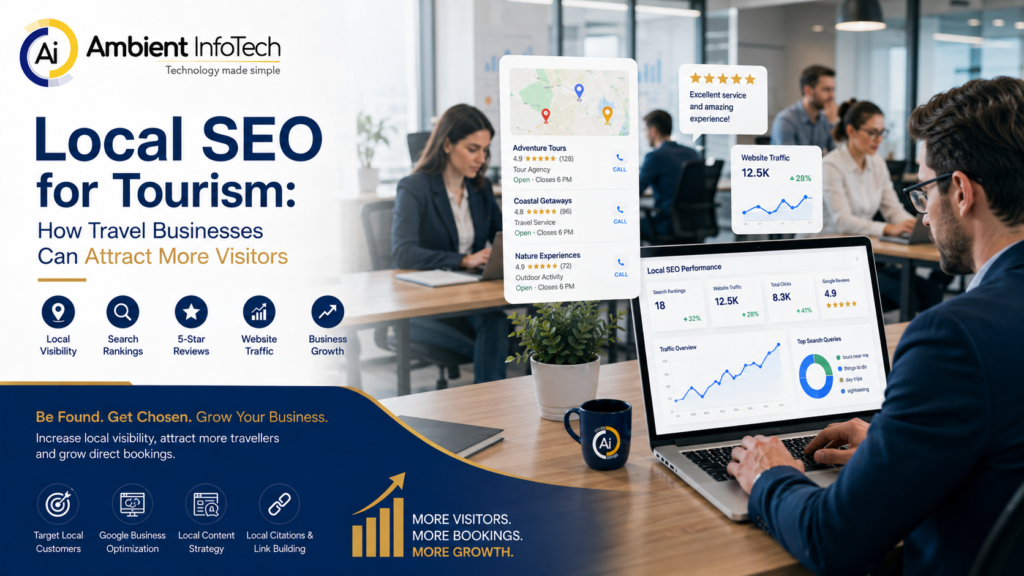
For UK hotels, travel agencies, tour operators, holiday parks, visitor attractions, museums, activity providers and other tourism businesses, local search visibility can directly influence enquiries, bookings and footfall. A well-optimised Google Business Profile, location-focused website content, positive reviews and technically sound website can put your business in front of travellers at exactly the right moment.
This guide explains how local SEO works for tourism businesses, what strategies matter most, common mistakes to avoid and how a professional SEO partner such as Ambient Infotech can help turn local searches into genuine tourism leads.
What Is Local SEO for Tourism?
Local SEO for tourism is the process of optimising a tourism business’s online presence so it appears prominently when people search for travel services, attractions, accommodation and experiences in a specific location.
It combines Google Business Profile optimisation, local keyword targeting, reviews, location pages, website SEO, citations, content and other signals that help search engines understand where your business operates and what it offers.
For example, a hotel in Bath could target searches such as:
- boutique hotel in Bath
- hotels near Bath city centre
- family-friendly hotels in Bath
- places to stay near Roman Baths
A tour operator in Scotland could target:
- Scottish Highlands tours
- day trips from Edinburgh
- guided tours in Inverness
- Loch Ness tours
The goal is simple: put your tourism business in front of people who are actively looking for what you offer in your location.
Why Local SEO for Tourism Matters in the UK
Tourism is inherently local.
Even when someone searches broadly for a holiday destination, the decision-making process eventually becomes location-specific. Travellers want to know where they can stay, what they can do, which attractions are nearby and how easy it is to reach them.
This makes local search particularly valuable for the UK tourism industry.
A traveller planning a weekend in Cornwall might search for:
“best things to do in Cornwall”
Then move towards:
“family attractions near St Ives”
And eventually:
“things to do near me”.
Every stage presents an opportunity for a tourism business to appear.
Strong Local SEO for Tourism Businesses helps you capture these searches before the traveller chooses a competitor.
It can help tourism businesses:
- Increase organic visibility.
- Appear in Google Maps.
- Generate more website visits.
- Increase calls and enquiries.
- Encourage direct bookings.
- Attract visitors searching within a specific destination.
- Reduce dependence on paid advertising.
- Build stronger local brand recognition.
Who Can Benefit from Local SEO for Tourism?
Local SEO isn’t limited to hotels.
Almost any tourism-related business can benefit from a strong local search strategy.
Hotels and Accommodation Providers
Hotels, B&Bs, guest houses, hostels, serviced apartments and holiday cottages can target travellers searching for accommodation in specific destinations.
This is where Hotel Local SEO becomes particularly valuable.
Instead of competing only for broad terms such as “hotels UK”, a business can target highly relevant searches such as:
- luxury hotel in Manchester
- boutique hotel in Brighton
- dog-friendly hotel in the Lake District
- family hotel near Windsor Castle
These searches generally have much stronger local intent.
Tour Operators
Tour companies can optimise for specific experiences and destinations.
Examples include:
- London walking tours
- Cotswolds day tours
- Scotland whisky tours
- Lake District hiking tours
- Yorkshire heritage tours
This makes Travel SEO Services especially useful for tour operators competing for destination-specific searches.
Travel Agencies
Travel agencies can use local SEO to attract customers searching for travel advice and holiday services in their area.
Local SEO Services for Travel Agencies can focus on location-specific landing pages, service pages, Google Business Profile optimisation, reviews and useful travel content.
Visitor Attractions
Museums, castles, zoos, theme parks, galleries and historical sites can target searches such as:
- attractions in London
- things to do in Chester
- family attractions in Birmingham
- museums near Liverpool
Activity and Experience Providers
Adventure companies, boat tours, cycling experiences, escape rooms, water sports businesses and other experience providers can all benefit from local search visibility.
Holiday Parks and Camping Businesses
Holiday parks and campsites can target location-based searches related to camping, caravanning, glamping and family holidays.
How Local SEO Helps Generate Tourism Leads
Ranking higher is useful, but rankings alone don’t pay the bills.
The real objective is to turn search visibility into enquiries and bookings.
A strong local SEO campaign should therefore follow this journey:
Google Search → Business Profile/Website → Trust → Enquiry → Booking
For example, someone searches:
“romantic weekend breaks in the Cotswolds”
They discover your website.
They check your photographs, reviews, pricing, location and available experiences.
They then call your business or make a direct booking.
That is a qualified tourism lead.
This is why successful Local Search Marketing for Tourism should focus on both visibility and conversion.
1. Optimise Your Google Business Profile
Google Business Profile is one of the most important assets for a local tourism business.
A complete and properly optimised profile can help your business appear in Google Maps and local search results.
Your profile should contain:
- Correct business name.
- Accurate address.
- Current telephone number.
- Website URL.
- Opening hours.
- Appropriate business categories.
- High-quality photographs.
- Services or products.
- Booking information.
- Regular updates where appropriate.
For tourism businesses, photographs are particularly important.
A hotel should showcase rooms, facilities, dining areas and exterior views.
A tour operator can showcase destinations, vehicles, guides and customer experiences.
An attraction can showcase exhibits, facilities and popular experiences.
This makes Google Business Profile for Tourism more than an SEO exercise. It becomes a digital storefront.
2. Target Location-Based Keywords
Generic keywords can be extremely competitive.
Instead of trying to rank for:
“hotel”
target:
“boutique hotel in York”
Instead of:
“tour operator”
target:
“Scottish Highlands tour operator”
Instead of:
“things to do”
target:
“things to do in Bath with children”
This approach is known as local keyword targeting.
The best keywords usually combine:
Service + Location + Search Intent
For example:
Luxury hotel + Edinburgh + near city centre
This type of search provides valuable context about what the user wants.
3. Build Dedicated Location Pages
If your tourism business serves multiple destinations, location pages can significantly expand your search visibility.
For example, a tour company operating across southern England might create pages targeting:
- London tours
- Oxford tours
- Cambridge tours
- Cotswolds tours
- Brighton tours
However, these pages must contain genuinely useful information.
Simply replacing a city name throughout identical content creates thin or repetitive pages and can damage the quality of your website.
Each location page should include unique information about:
- The destination.
- Your services there.
- Popular attractions.
- Local travel information.
- Frequently asked questions.
- Nearby landmarks.
- Relevant booking information.
This is a core part of Tourism SEO Services UK because it allows businesses to reach travellers searching for specific destinations.
4. Build a Tourism Content Strategy
Travellers ask hundreds of questions before booking.
Your website should answer them.
Useful blog topics include:
- Best things to do in London for first-time visitors
- A weekend itinerary for Edinburgh
- Best family attractions in Yorkshire
- When is the best time to visit Cornwall?
- How to spend three days in the Lake District
- Best romantic destinations in Wales
- What to pack for a Scottish Highlands tour
These articles can attract people earlier in their buying journey.
Someone searching for “best things to do in York” may not be ready to book a tour today.
But if your content helps them plan their trip, they may remember your brand and eventually become a customer.
That is how content supports long-term tourism marketing.
5. Generate More Genuine Reviews
Reviews are extremely important for tourism businesses because travellers want reassurance before spending money.
Think about your own booking behaviour.
Would you rather choose a hotel with dozens of recent positive reviews or a similar hotel with almost no feedback?
The difference can be significant.
Encourage genuine customers to leave honest reviews after their experience.
Focus on providing an excellent service first. Then make it easy for satisfied customers to share their experience.
Never buy fake reviews or create misleading feedback.
Reviews can strengthen trust, improve conversion rates and support your local search presence.
6. Optimise Your Website for Mobile Users
Tourists frequently search while travelling.
They may be:
- Standing at a train station.
- Exploring a city.
- Looking for a nearby restaurant.
- Searching for an attraction.
- Comparing hotels.
- Checking directions.
A slow or difficult-to-use website can quickly lose that customer.
Your tourism website should therefore provide:
- Fast loading speeds.
- Responsive design.
- Simple navigation.
- Clear contact information.
- Easy booking options.
- Click-to-call functionality.
- Secure payment processes.
- Easy-to-read content.
Website usability is an essential part of tourism website optimisation.
7. Use Local Structured Data
Schema markup can help search engines understand important information about your business.
Depending on the business type and website structure, relevant structured data may include:
- LocalBusiness
- Hotel
- TouristAttraction
- TravelAgency
- Event
- FAQPage
- BreadcrumbList
Structured data should accurately represent information already available on the website.
It shouldn’t be used to make unsupported claims or manipulate search results.
8. Build Relevant Local Citations
Citations are online mentions of your business information, usually including the business name, address and phone number.
For tourism businesses, relevant places can include:
- Local tourism directories.
- Regional business directories.
- Destination websites.
- Travel directories.
- Industry associations.
- Local publications.
Consistency matters.
If your business has different addresses or telephone numbers across multiple listings, it can create confusion for both customers and search engines.
9. Create Local Partnerships and Earn Links
Local businesses have an advantage that national brands often don’t: relationships.
A hotel might partner with:
- Local attractions.
- Restaurants.
- Wedding venues.
- Tour operators.
- Museums.
- Event organisers.
- Regional tourism organisations.
These relationships can create opportunities for genuine mentions and relevant backlinks.
For example, a hotel could create a local guide featuring nearby attractions and collaborate with those businesses.
This approach makes link building more natural and useful.
Local SEO Strategy for Different Tourism Businesses
| Tourism Business | Key Local SEO Focus |
|---|---|
| Hotels | Google Business Profile, accommodation keywords, reviews |
| Travel Agencies | Local service pages, reviews, travel content |
| Tour Operators | Destination keywords, experience pages, local content |
| Tourist Attractions | Attraction pages, Maps visibility, events |
| Holiday Parks | Location pages, seasonal content, reviews |
| B&Bs | Local keywords, Google Maps, photographs |
| Museums | Attraction SEO, events, informational content |
| Adventure Businesses | Experience keywords, location pages, reviews |
| Holiday Rentals | Property pages, destination content, local SEO |
| Visitor Centres | Local guides, Maps, destination searches |
Local SEO vs Paid Advertising for Tourism
Both SEO and paid advertising can play a role in a tourism marketing strategy, but they work differently.
| Factor | Local SEO | Paid Advertising |
| Traffic source | Organic | Paid |
| Long-term value | High | Depends on budget |
| Immediate visibility | Moderate | High |
| Cost per click | No direct CPC | Yes |
| Local Maps visibility | Strong | Limited/varies |
| Content benefits | High | Lower |
| Brand authority | Builds over time | Limited |
| Best use | Sustainable growth | Immediate campaigns |
A sensible tourism business doesn’t necessarily need to choose one.
SEO can build long-term visibility while paid campaigns support seasonal promotions, new services and immediate demand.
What Does Local SEO Cost for a UK Tourism Business?
There is no single price for local SEO because the investment depends on factors such as:
- Business size.
- Number of locations.
- Competition.
- Website condition.
- Number of services.
- Existing domain authority.
- Content requirements.
- Technical issues.
- Link-building requirements.
A small local tourism business may need a focused campaign targeting a handful of locations, while a national hotel or travel brand may require an enterprise SEO strategy.
The important question isn’t simply “How much does SEO cost?”
Instead, ask:
How much revenue could additional qualified organic traffic generate?
For example, if an SEO campaign generates 500 additional relevant visitors each month and even a small percentage become paying customers, the long-term commercial value can significantly outweigh the initial SEO investment.
Common Local SEO Mistakes Tourism Businesses Make
Using the Same Content for Every Location
Creating dozens of pages with only the city name changed provides little value.
Create genuinely useful local content instead.
Ignoring Google Reviews
A tourism business with an incomplete or poorly maintained profile can lose trust before customers even visit the website.
Targeting Only Broad Keywords
“Travel agency” may have enormous competition.
Location-specific commercial keywords can often provide more qualified opportunities.
Forgetting Seasonal SEO
Tourism demand changes throughout the year.
Create content and landing pages around relevant seasons, holidays, events and booking periods.
Ignoring Mobile Search
Tourists often search from smartphones. A poor mobile experience can directly cost bookings.
Focusing Only on Rankings
A number-one ranking isn’t enough if visitors don’t enquire or book.
Track calls, enquiries, bookings and revenue—not rankings alone.
How to Choose a Local SEO Agency for Your Tourism Business
Choosing an SEO agency is a significant business decision.
Before signing a contract, look for an agency that understands both SEO and tourism.
Ask potential agencies:
Do you understand the tourism industry?
The agency should understand seasonality, destination searches, travel intent and booking behaviour.
Can you demonstrate relevant experience?
Look for genuine case studies, examples and measurable outcomes.
How will you measure success?
Important metrics include:
- Organic traffic.
- Qualified enquiries.
- Phone calls.
- Booking requests.
- Direct bookings.
- Conversion rates.
- Local search visibility.
Will the strategy be customised?
Your SEO strategy should reflect your destination, customers, services and competitors.
Do you provide transparent reporting?
You should understand what work is being completed and how it contributes to business growth.
Why Choose Ambient Infotech for Tourism SEO?
For tourism businesses that want SEO to contribute directly to lead generation, Ambient Infotech offers a broader digital growth approach.
The company combines SEO with web development, UI/UX, digital marketing and technical expertise. This matters because local search performance doesn’t exist separately from the website experience.
A visitor may discover your business through Google Maps but then leave if your website is slow.
They may read an excellent destination article but fail to find a clear booking option.
They may discover your hotel through search but choose a competitor because your website doesn’t communicate trust.
Ambient Infotech’s approach connects these different parts of the customer journey.
Its tourism-focused strategy can include:
- Local keyword research.
- Google Business Profile optimisation.
- Technical SEO.
- Tourism content strategy.
- Location landing pages.
- On-page optimisation.
- Internal linking.
- Local citation management.
- Link-building campaigns.
- Conversion optimisation.
- Website performance improvements.
- SEO reporting and ongoing support.
With 12+ years of experience and 1,200+ projects delivered, Ambient Infotech can support tourism businesses at different stages of digital growth, from smaller local operators to businesses serving multiple destinations.
The objective isn’t simply to make a tourism website rank.
It’s to make the website visible, useful and commercially effective.
Step-by-Step Local SEO Plan for a UK Tourism Business
If you’re starting from scratch, follow this process.
Step 1: Audit Your Existing Visibility
Check where your business currently appears for important local searches.
Step 2: Research Local Keywords
Identify searches combining your service, destination and customer intent.
Step 3: Optimise Your Google Business Profile
Complete every relevant section and keep information accurate.
Step 4: Improve Your Website
Fix technical SEO issues, improve mobile performance and simplify navigation.
Step 5: Create Location Pages
Develop genuinely useful pages for important destinations you serve.
Step 6: Publish Helpful Tourism Content
Answer the questions your target travellers ask before booking.
Step 7: Build Reviews
Encourage genuine customers to share their experiences.
Step 8: Earn Relevant Local Links
Develop partnerships and useful resources that naturally attract mentions.
Step 9: Track Leads
Measure calls, enquiries, booking requests and organic conversions.
Step 10: Improve Continuously
SEO isn’t a one-time task. Search behaviour, competitors and travel trends change constantly.
Key Takeaway
Local SEO for Tourism is about much more than getting a tourism website to rank on Google.
It is about connecting your business with travellers at the exact moment they are searching for accommodation, attractions, tours, experiences and travel services in your area.
For UK tourism businesses, the strongest strategy combines:
Google Business Profile + Local Keywords + Website SEO + Reviews + Useful Content + Local Authority + Conversion Optimisation
When these elements work together, local search can become a consistent source of qualified tourism leads.
Frequently Asked Questions
1. What is Local SEO for Tourism?
Local SEO for tourism helps hotels, travel agencies, tour operators, attractions and other tourism businesses appear in Google Search and Maps when travellers search for services in a specific destination.
2. How can local SEO generate tourism leads?
Local SEO places your business in front of travellers with relevant search intent. Optimised profiles, location pages, reviews and conversion-focused websites can turn those visitors into calls, enquiries and bookings.
3. Is Google Business Profile important for tourism businesses?
Yes. Google Business Profile can help tourism businesses appear in Google Maps and local search results while providing customers with important information such as location, opening hours, photographs, reviews and website details.
4. How long does tourism local SEO take?
Results vary according to competition, website quality, location and existing authority. Some improvements can appear relatively quickly, while competitive tourism searches usually require consistent SEO work over several months.
5. Why should a tourism business hire an SEO agency?
An experienced SEO agency can handle technical optimisation, keyword research, local search, content, link building and conversion improvements while allowing tourism businesses to focus on serving their customers.