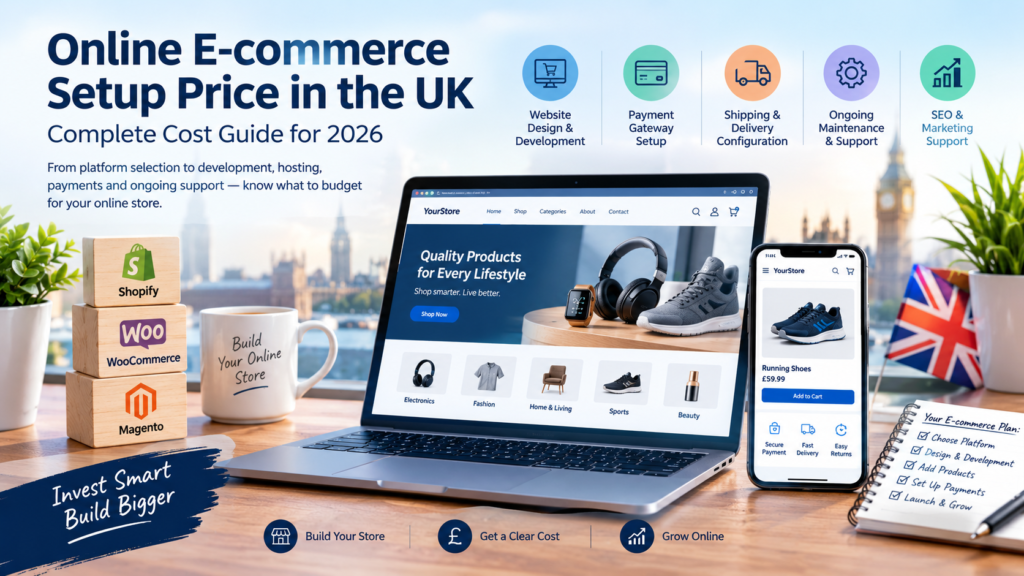





The online e-commerce setup price in UK is one of the first things businesses need to understand before launching an online shop. Whether you are a startup selling a handful of products or an established retailer planning to move your business online, knowing the likely costs helps you choose the right platform, plan your budget and avoid unexpected expenses.
In 2026, a professionally built e-commerce website in the UK can cost approximately £2,000–£6,000 for a starter store, £6,000–£20,000 for a more customised solution, and £20,000–£50,000 or more for a complex or enterprise-level project. These are indicative market ranges rather than fixed prices; smaller DIY projects can cost considerably less, while specialist integrations and bespoke functionality can increase the budget. Ambient Infotech 2026 UK cost guide provides a similar breakdown.
The final cost depends on several factors, including the platform you choose, design requirements, product catalogue, payment methods, delivery options, integrations and ongoing maintenance.
In this guide, we explain the typical costs of setting up an online store in the UK, compare popular e-commerce platforms, break down ongoing expenses and explain how to choose a solution that supports your business goals.
How Much Does an E-commerce Website Cost in the UK?
The eCommerce website cost UK businesses should budget for depends mainly on the size and complexity of the project.
Here is an indicative overview of common project types.
| Type of online store | Estimated setup cost | Suitable for |
|---|---|---|
| DIY or basic store | £300–£2,000 | Entrepreneurs with simple requirements who can handle setup themselves |
| Starter professional store | £2,000–£6,000 | Small businesses and new online retailers |
| Customised e-commerce website | £6,000–£20,000 | Growing brands needing tailored design and additional functionality |
| Advanced e-commerce platform | £20,000–£50,000+ | Established retailers requiring integrations, automation or complex workflows |
| Enterprise or highly bespoke platform | £50,000+ | Large businesses with extensive technical and operational requirements |
These figures are planning estimates, not guaranteed quotations. The lower end may cover a simple theme-based setup, while the higher end can involve extensive development, system integrations, data migration and custom functionality.
Before comparing prices, check precisely what each quotation includes. A low-cost package may cover only the initial design and installation, whereas a comprehensive proposal may include product configuration, payment setup, testing, launch support and training.
What Affects the Online E-commerce Setup Price in the UK?
Understanding the factors behind the price makes it easier to allocate your budget effectively.
1. Website Design and Customisation
Design influences how customers experience your store and how easily they can find products.
A basic store using a ready-made theme generally costs less than a fully customised website designed around your brand, products and customer journey.
A professional e-commerce design may include:
- A branded homepage and navigation system.
- Product listing and product detail pages.
- Category pages and search functionality.
- Mobile-friendly layouts.
- Shopping cart and checkout pages.
- Customer account pages.
- Clear calls to action.
A theme-based design may be sufficient for a new business with a straightforward catalogue. However, a growing retailer may benefit from a tailored design that improves product discovery, strengthens brand identity and supports conversion optimisation.
2. E-commerce Platform
Your chosen platform affects initial development costs, monthly fees, flexibility and future maintenance.
The most common options include Shopify, WooCommerce, Magento Open Source and other hosted or custom-built solutions.
For example, Shopify provides managed hosting and an integrated commerce environment, while WooCommerce runs on WordPress and gives businesses greater control over hosting and extensions.
The right choice depends on your technical requirements, available budget, internal resources and growth plans.
3. Number of Products and Product Variations
A store selling 20 products is generally simpler to configure than one containing 2,000 products with multiple sizes, colours, specifications or other variations.
Product-related costs can include:
- Product data entry.
- Image preparation and optimisation.
- Category organisation.
- Product descriptions.
- Stock and SKU configuration.
- Product variations.
- Bulk product imports.
- Product filters and search.
If you already have accurate product data in a spreadsheet or existing system, importing it may reduce manual work. However, cleaning inconsistent data and organising a large catalogue can require additional development time.
4. Payment Gateway Integration
Customers expect a secure and straightforward checkout experience.
Depending on your business, you may need to support debit and credit cards, digital wallets, PayPal or other payment methods.
Development costs can include configuring the payment gateway, testing successful and failed transactions, handling order confirmations and checking the refund process.
Payment processing fees are separate from the website development price. These charges generally depend on your provider, transaction type and commercial agreement.
5. Delivery and Shipping Configuration
Shipping requirements also affect the cost of an online store.
A small retailer may need only standard delivery rates and a collection option. A larger business may require location-based delivery, weight-based calculations, international shipping, multiple couriers or fulfilment integrations.
Your development brief should specify delivery zones, shipping prices, free-delivery thresholds, dispatch rules and any restrictions on particular products.
Getting these details right before launch helps prevent checkout problems and customer confusion.
6. Third-Party Integrations
Integrations can significantly increase the online store development cost when a business needs its website to communicate with other systems.
Common integrations include:
- Accounting software.
- Customer relationship management systems.
- Enterprise resource planning platforms.
- Inventory and warehouse management.
- Email marketing tools.
- Shipping and fulfilment systems.
- Customer support software.
- Product information management systems.
A straightforward integration may require limited configuration, while a complex integration involving custom APIs, synchronisation rules and error handling can require substantial development work.
Shopify vs WooCommerce vs Magento: Which Is More Cost-Effective?
Choosing a suitable platform is an important part of managing the eCommerce website development UK budget.
| Platform | Initial development budget | Ongoing cost considerations | Best suited to |
|---|---|---|---|
| Shopify | Approximately £2,000–£8,000 for many professionally configured starter projects | Subscription, apps, payment processing and optional development support | Startups, retailers and businesses seeking managed hosting |
| WooCommerce | Approximately £3,000–£10,000 for many professional builds | Hosting, extensions, security, maintenance and payment processing | Businesses wanting WordPress flexibility and greater control |
| Magento Open Source | Often £8,000–£25,000+ for more involved professional projects | Hosting, technical maintenance, extensions and developer support | Retailers with more demanding catalogues and workflows |
| Custom e-commerce development | Approximately £15,000–£50,000+ depending on scope | Hosting, ongoing development, security and system maintenance | Businesses needing specialised workflows or functionality |
These are broad planning ranges, not platform-mandated prices. A simpler project may cost less, and a large migration or highly customised implementation may cost considerably more.
Shopify Website Setup Cost in the UK
Shopify is a popular option for businesses that want to launch an online shop without managing their own web server.
A typical Shopify website cost UK estimate needs to account for the development work and the recurring subscription.
A professionally configured Shopify store may include theme setup, branding, product categories, payment configuration, delivery settings, essential apps and checkout testing.
The total increases if you require custom theme development, complex product options, subscriptions, wholesale pricing or integrations with external business systems.
Shopify can be a practical choice for startups and established businesses that value a managed platform and a relatively straightforward administration experience.
WooCommerce Website Setup Cost in the UK
WooCommerce is an e-commerce plugin for WordPress. The core software is free, but running a professional store still involves costs for hosting, design, development, security and potentially paid extensions.
A WooCommerce website cost UK estimate should therefore include the full setup rather than the price of the plugin alone.
WooCommerce may suit businesses that want greater control over their website, content strategy and custom functionality.
It can also be useful for companies that already have a WordPress website and want to introduce online sales without rebuilding everything on another platform.
Magento E-commerce Setup Cost
Magento Open Source can support extensive product catalogues and complex retail requirements, but implementation and ongoing technical management may be more demanding.
Businesses considering Magento should assess hosting, performance, extensions, security, developer availability and integration requirements before committing to the platform.
It can be appropriate for retailers whose operational requirements justify a more involved technical solution.
What Is Included in a Professional E-commerce Website Setup?
When comparing proposals from an eCommerce development company UK, look beyond the headline price.
A professional setup may include the following components, depending on the agreed scope.
Website Planning and Structure
This stage defines the target audience, product categories, navigation, core pages and customer journey.
A clear structure helps visitors find products and makes the store easier to manage.
Responsive Website Design
The store should work across mobile phones, tablets and desktop computers.
Product information, images, navigation and checkout controls must remain usable on smaller screens.
Product Catalogue Setup
This may involve creating categories, adding product details, configuring variations, importing product data and setting stock information.
The quotation should specify how many products are included in the initial setup.
Payment and Delivery Configuration
The development team configures the agreed payment methods, delivery rules, taxes and order notifications.
The business should provide accurate commercial information and confirm its own legal and tax obligations.
Essential Technical SEO
An e-commerce website should have a crawlable structure, appropriate page titles, descriptive URLs, optimised images, internal links and a suitable XML sitemap.
Product and organisation structured data may also be relevant where supported and implemented correctly.
SEO setup provides a foundation for organic visibility, but it does not guarantee rankings or immediate sales.
Testing and Launch
Before launch, the store should be tested for mobile usability, product display, checkout functionality, payment processing, order emails, delivery rules and key integrations.
The final handover should clarify administrator access, training, backups and ongoing support arrangements.
Ongoing E-commerce Website Costs in the UK
The initial development invoice is only part of the total investment. Businesses should also budget for operating and maintaining the store.
| Expense | Indicative budget | Notes |
|---|---|---|
| Domain name | £10–£30 per year | Depends on extension and registrar |
| Hosted e-commerce platform | £20–£300+ per month | Depends on platform and plan |
| Managed hosting for self-hosted stores | £20–£150+ per month | Depends on traffic and server requirements |
| Maintenance and support | £50–£500+ per month | Depends on service level and complexity |
| Paid apps and extensions | £0–£200+ per month | Depends on the features used |
| SEO services | Project or monthly retainer | Depends on competition, scope and goals |
| Payment processing | Per transaction | Depends on provider and payment method |
These are indicative planning allowances rather than guaranteed provider prices. Some costs overlap or may not apply to your platform, so avoid adding every line together without checking what is already included.
For instance, a hosted platform may include hosting and core security features, while a self-hosted WooCommerce store requires separate hosting arrangements and a clear maintenance plan.
Why Maintenance Matters
Regular maintenance helps keep your store secure, functional and reliable.
Depending on the platform, it may involve updates, backups, bug fixes, performance checks, monitoring, compatibility testing and support for checkout issues.
Businesses should also understand who is responsible for urgent fixes and what happens if a third-party plugin or integration stops working.
How Much Should a Small Business Budget for an Online Store?
For a small UK business launching its first online shop, a practical budget might fall into one of three categories.
Starter budget: £2,000–£4,000
Suitable for a relatively straightforward store using an established platform and theme. The scope may include essential pages, a limited product catalogue, standard payments and basic delivery configuration.
Growth-focused budget: £4,000–£10,000
Suitable for businesses requiring more polished branding, a larger catalogue, improved navigation, additional features and a more thorough launch process.
Advanced budget: £10,000–£25,000+
Suitable for retailers needing substantial customisation, complex product options, business-system integrations, data migration or more advanced operational workflows.
These bands are examples to support early planning. The right budget should be based on a defined project scope rather than a target price alone.
How to Reduce E-commerce Setup Costs Without Sacrificing Quality
Reducing unnecessary complexity can help businesses make better use of their budget.
Start With Essential Features
Identify what is required to begin selling. Features such as basic product search, payments, delivery configuration and order notifications are often more important at launch than advanced personalisation or complicated automation.
Choose a Platform That Fits Your Requirements
Avoid paying for a complex platform if a simpler solution can handle your products and processes.
Equally, do not select the cheapest option if it will create expensive limitations as the business grows.
Prepare Product Data in Advance
Organised product names, descriptions, prices, images, SKUs and stock information can reduce manual setup time.
Prioritise Mobile Usability
Mobile usability should be part of the initial design rather than an optional improvement after launch.
Plan Integrations Carefully
List the systems that genuinely need to exchange data. Confirm the required fields, synchronisation frequency and error-handling process before development begins.
Compare Quotes by Scope
Ask every provider to quote against the same requirements. A proposal that includes testing, training and launch support may offer better overall value than a cheaper package that excludes these tasks.
How Ambient Infotech Can Help With E-commerce Development
Ambient Infotech provides digital development services for businesses that want to establish or improve their online presence.
For UK retailers, the right eCommerce website design UK solution should combine a professional storefront with reliable product management, a straightforward checkout and a structure that can support future growth.
Ambient Infotech can help businesses explore solutions involving Shopify, WooCommerce, Magento and custom e-commerce development, depending on the project’s requirements.
The scope may include:
- E-commerce website design and development.
- Product and category configuration.
- Payment gateway and delivery integration.
- Website migration and redesign.
- Technical SEO foundations.
- CRM and ERP integration.
- Inventory and order management.
- Website maintenance and ongoing support.
Businesses that need custom eCommerce development UK services should establish their requirements before choosing a platform. The aim is to build a solution that supports the way the business sells, fulfils orders and manages customers.
Rather than selecting features simply because they are available, it is better to prioritise those that solve real operational problems and contribute to a better customer experience.
Common Mistakes to Avoid When Budgeting for an Online Store
Focusing Only on the Initial Price
A low setup fee does not necessarily mean a low total cost. Include subscriptions, hosting, maintenance, extensions and transaction fees in your financial plan.
Choosing a Platform Without Considering Growth
Think about your expected product range, sales channels, international markets and integration requirements over the next few years.
Underestimating Product Setup
A large catalogue with inconsistent data can take considerable time to organise and import.
Ignoring SEO Until After Launch
Planning site architecture, URLs, product categories and technical SEO from the beginning can reduce avoidable rework.
Overlooking Support and Ownership
Confirm who owns the domain, hosting account, website code, platform account and licences. Make sure you understand what support is included after launch.
Frequently Asked Questions
1. How much does it cost to set up an online store in the UK?
A professionally built starter store may cost approximately £2,000–£6,000, while a more customised project can cost £6,000–£20,000 or more. The final price depends on the platform, design, catalogue, features and integrations.
2. What is the cheapest way to start an e-commerce business in the UK?
A DIY store using an established platform and ready-made theme is often the lowest-cost option. However, the owner must account for subscriptions, payment processing, product setup, delivery configuration and the time required to manage the website.
3. Is Shopify cheaper than WooCommerce?
It depends on the requirements. Shopify combines hosting and platform management in a subscription, whereas WooCommerce has free core software but requires hosting and ongoing technical management. Compare the total cost over several years rather than looking only at the initial price.
4. How much does a professional e-commerce website cost?
A professional store may cost a few thousand pounds for a straightforward implementation and considerably more for custom design, advanced features, integrations or migration. Ask for an itemised quotation that clearly states what is included.
5. How long does it take to build an e-commerce website?
A simple store may take a few weeks, while a customised project can take several months. Product data readiness, design approvals, integrations and testing all influence the timeline.
6. Does the e-commerce setup price include SEO?
Not always. Some providers include basic technical SEO, while keyword research, content development, ongoing optimisation and link acquisition may be charged separately. Confirm the exact SEO deliverables before signing an agreement.
7. Are payment gateway fees included in the website price?
Usually, payment processing charges are separate. Providers generally charge according to their pricing model and transaction terms. Review these fees when estimating your operating costs.
8. Can Ambient Infotech build an e-commerce website for a UK business?
Ambient Infotech can discuss e-commerce development options for UK businesses, including platform-based stores, customised websites, integrations and ongoing support. The appropriate solution and price depend on the project’s requirements and agreed scope.
Conclusion
The online e-commerce setup price in UK varies according to the type of store you need, the platform you choose and the functionality required to operate your business.
A straightforward store may be achievable with a modest budget, while a customised e-commerce platform with complex integrations requires a larger investment. Businesses should also plan for ongoing subscriptions, hosting, payment processing, maintenance and marketing.
The best approach is to define your requirements, compare proposals carefully and select a platform that meets your current needs without creating unnecessary barriers to future growth.
Ambient Infotech can help you explore an e-commerce solution aligned with your business goals, from website design and development to integrations, technical SEO and ongoing support.
Planning to launch an online store in the UK? Start with a clear feature list and budget, then request a tailored development quotation based on your products, customers and long-term plans.