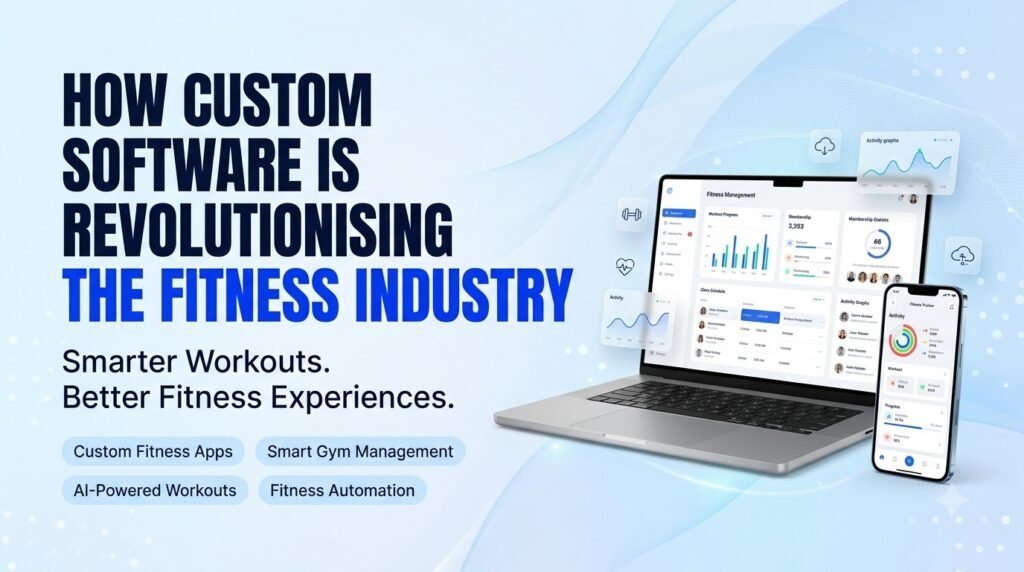





The fitness industry is evolving beyond traditional gym memberships and face-to-face personal training. Today, members expect convenient class bookings, personalised workout plans, digital membership management, online coaching, and access to their fitness progress from anywhere. For gym owners, fitness studios, personal trainers, and wellness entrepreneurs, technology has become an important part of delivering these experiences while managing day-to-day operations.
Custom software development for the fitness industry enables businesses to build digital solutions around their specific services, operational requirements, and customer expectations. Instead of adapting every process to a generic platform, fitness businesses can develop applications that connect memberships, bookings, payments, training programmes, customer communication, and performance reporting.
From mobile fitness applications to automated administrative systems, the right technology can help businesses reduce repetitive tasks, improve member engagement, and introduce new revenue opportunities. However, successful implementation depends on choosing features that solve genuine problems rather than adding technology for its own sake.
In this article, we explore how custom fitness software development is changing the way fitness businesses operate, serve their members, and prepare for sustainable growth.
Why the Fitness Industry Needs Custom Software Solutions
Modern fitness businesses often manage several connected activities simultaneously. A gym might handle membership renewals, personal training appointments, group classes, payments, attendance records, and customer enquiries. A fitness startup may need to coordinate online subscriptions, video workouts, trainer communication, and mobile app access.
When these activities rely on disconnected systems, staff may need to enter the same information repeatedly, resolve booking conflicts manually, or search across multiple tools to understand a member’s history.
Generic software can cover common requirements, but it may not accommodate every business model. A boutique Pilates studio, a multi-location gym, and an online personal training company have different workflows and customer expectations.
Custom software can address these differences by bringing relevant processes together in one connected environment. For example, a fitness studio could create a system that manages class capacity, trainer availability, recurring memberships, and payment status through a central dashboard. Members could then book sessions independently while staff retain control over scheduling changes.
The main objective is to make operations more consistent and the customer experience more convenient. A well-planned system should also integrate with existing tools wherever practical, avoiding unnecessary disruption to established workflows.
How Fitness App Development Services Improve Member Experiences
Members increasingly expect fitness services to be accessible beyond the gym floor. A mobile application can extend a fitness business’s relationship with its customers, making it easier to follow programmes, manage appointments, and stay connected with trainers.
Fitness app development services can help businesses create mobile experiences suited to their audience, whether they serve gym members, independent clients, sports teams, or online fitness communities.
Essential features of a custom fitness app
A fitness application may include:
-
Member profiles: Store membership details, fitness preferences, goals, and relevant training information.
-
Personalised workout plans: Provide exercise routines based on trainer-approved programmes and individual requirements.
-
Workout tracking: Record completed sessions, repetitions, exercise duration, and progress over time.
-
Exercise demonstrations: Offer instructional videos, written guidance, and technique references.
-
Class and trainer bookings: Allow members to view availability, reserve sessions, and manage appointments.
-
Membership and payments: Display subscription status, renewal dates, invoices, and payment options.
-
Notifications and reminders: Send relevant updates about upcoming classes, renewals, or programme check-ins.
-
Virtual coaching: Support online programmes, video consultations, and communication between trainers and clients.
Consider a fitness studio that offers strength training and small-group classes. Its app could let members reserve sessions, receive reminders, and access their assigned workouts without contacting reception for every request.
The best feature set depends on the business model. An independent personal trainer may need programme delivery and client messaging, while a larger gym may prioritise membership management, class reservations, and multi-location access. Starting with these practical requirements helps avoid unnecessary complexity and development costs.
Simplifying Gym Operations With Fitness Business Automation
Administrative work can consume a significant amount of time in fitness businesses. Staff may repeatedly follow up on unpaid invoices, confirm bookings, send renewal reminders, update attendance records, and respond to routine membership questions.
Fitness business automation can streamline these tasks by connecting business rules with routine workflows. Instead of relying entirely on manual reminders and spreadsheets, a fitness business can configure software to trigger appropriate actions when specific events occur.
For example, a membership management system could send a renewal reminder before a subscription expires. When a customer books a class, the system could issue a confirmation and update the available capacity. If a payment fails, it could notify the member and flag the account for follow-up.
Other useful automation opportunities include:
-
Trainer scheduling and appointment confirmations.
-
Attendance records and class participation reports.
-
Lead follow-ups for prospective members.
-
Payment notifications and recurring subscription administration.
-
Member feedback requests and customer communication.
-
Management dashboards showing membership activity and revenue trends.
Automation does not eliminate the need for staff oversight. Payment disputes, unusual booking requests, cancellations, and sensitive customer concerns may still require personal attention.
The real benefit is reducing repetitive work while helping employees focus on member relationships, service quality, and business development.
The Role of Custom Gym Management Software
A reliable gym management software platform connects the operational activities that keep a fitness business running. Instead of maintaining separate records for memberships, trainers, payments, and class bookings, businesses can manage these functions through a central system.
A customised fitness studio management system may include the following capabilities.
Membership and attendance management
Staff can create membership plans, manage renewals, record attendance, and monitor subscription status. Depending on the setup, the system can also connect with compatible entry-control devices to support member access.
Trainer and facility scheduling
Trainer profiles can include availability, qualifications, assigned clients, and scheduled sessions. Businesses that manage courts, specialist equipment, or studio rooms can also introduce resource-booking rules to reduce scheduling conflicts.
Billing and financial reporting
Integrated billing tools can manage recurring charges, invoices, discounts, and payment status. Management dashboards can present revenue by membership type, outstanding payments, and membership changes. Accounting integrations may reduce duplicate data entry, although financial reporting still depends on accurate records and appropriate configuration.
Multi-location administration
For businesses operating several facilities, a central platform can provide visibility into memberships, schedules, and performance across locations. Access permissions can allow local managers to handle their own operations while authorised administrators oversee the wider business.
When is a custom system worthwhile?
A bespoke platform may be appropriate when a gym has unusual membership rules, specialised booking requirements, complex franchise operations, or integrations that existing products cannot adequately support.
Smaller facilities with straightforward requirements may find a ready-made platform more affordable and easier to implement. The decision should be based on the operational gaps, total cost of ownership, and likely value of customisation.
Personalised Fitness Through AI and Data Analytics
Personalisation is becoming an important part of digital fitness experiences. Members may have different goals, schedules, exercise preferences, and levels of training experience. Software can help organise this information so that trainers and members can make better-informed decisions.
A custom workout tracking app can record completed sessions, training frequency, and changes in selected performance measures. These records can feed into progress dashboards, giving users a clearer picture of their activity over time.
How AI can support fitness applications
AI-powered fitness applications can use available information to suggest relevant workouts, highlight changes in training consistency, or help users navigate exercise libraries.
For example, a training app might recommend a shorter workout when a member has limited time, provided the recommendation follows the programme rules established by the trainer. A coach-facing dashboard could identify clients who have missed several planned sessions, allowing the coach to check whether they need support or a revised schedule.
Useful applications include:
-
Workout suggestions based on recorded preferences and programme settings.
-
Progress visualisation using historical activity data.
-
Training consistency summaries and goal tracking.
-
Trainer dashboards for reviewing client participation.
-
Virtual assistants that answer routine questions about schedules and programmes.
However, data-driven recommendations have limitations. Incomplete records, inaccurate user inputs, and differences in individual circumstances can affect their usefulness. AI should not be treated as a substitute for qualified trainers, medical professionals, or appropriate clinical advice.
Fitness businesses should also explain how personal data is used and allow customers to understand the role of automated recommendations. Human review is particularly important when a recommendation could affect an individual’s safety or training suitability.
Transforming Personal Training and Online Fitness Coaching
Personal trainers increasingly serve clients through a combination of in-person sessions and remote coaching. Managing this hybrid model with messaging applications, spreadsheets, and separate payment tools can become difficult as the client base expands.
Custom personal training software provides a structured environment for delivering programmes, coordinating appointments, and tracking client communication.
Supporting the entire coaching process
A trainer could onboard a new client through a digital questionnaire covering goals, exercise preferences, training experience, and relevant limitations. The trainer could then assign an appropriate programme and make it available through a mobile or web application.
Clients could log completed workouts, share progress updates, and submit check-ins. Trainers could review this information before a scheduled consultation, helping them prepare more relevant feedback.
A well-designed online fitness platform may also support:
-
Video-based coaching sessions and appointment scheduling.
-
Exercise libraries and structured training programmes.
-
Trainer-client messaging and feedback.
-
Progress summaries and check-in reminders.
-
Subscription payments for digital programmes.
-
Client engagement and retention reporting.
For example, a personal trainer could offer one-to-one coaching at a local studio while selling a separate online strength-training programme to clients in other regions. The same underlying platform could manage appointments, digital programme access, and recurring subscriptions, subject to the business’s chosen pricing model.
This approach can create additional ways to serve customers without requiring every service to take place in person. Nevertheless, online coaching still requires a clear service offering, responsive communication, and appropriate professional oversight.
Wearable Technology and Fitness Software Integration
Wearable devices and connected health platforms can provide additional information about physical activity. When supported by compatible devices and authorised data connections, fitness applications can incorporate selected metrics into a member’s activity history.
Potential integrations include:
-
Step counts and general activity records.
-
Workout duration and recorded exercise sessions.
-
Heart rate data from supported devices.
-
Synchronisation with compatible health platforms.
-
Visual summaries of activity trends and training consistency.
Imagine a fitness studio whose members use different supported wearables. With suitable integrations and user permission, its app might display selected activity records alongside completed training sessions. Members could then review their overall activity in one place rather than switching between several applications.
Integration requires careful planning
Not all devices measure activity in the same way, and not every platform provides access to the same data. Differences in device capabilities, operating systems, APIs, and permissions can affect what an application can retrieve.
Businesses should assess device compatibility, data quality, synchronisation behaviour, and third-party platform requirements before committing to a feature. They should also obtain appropriate consent, minimise unnecessary data collection, and explain how information is stored and used.
Wearable device integration is most useful when the connected data serves a clear purpose for members or trainers. Collecting more information is not automatically better if it does not improve the service.
How Custom Fitness Software Supports Business Growth
Growth often introduces operational complexity. A gym that begins with a single facility may later add locations, new membership tiers, online coaching, or corporate wellness programmes. Systems that worked at a small scale may become difficult to maintain when the business expands.
Custom fitness business management software can provide a foundation for managing these changes without rebuilding every workflow from scratch.
Expanding services and revenue models
A fitness business could introduce digital memberships, paid video programmes, remote coaching, or premium subscription options. The software can manage programme access, subscription status, bookings, and customer communication according to the selected business rules.
Improving lead and member management
Fitness CRM software can help organise enquiries, record interactions, track prospective members, and schedule follow-ups. When connected to marketing and booking systems, it can give staff a clearer view of the customer journey, from initial enquiry to active membership.
Making decisions with business analytics
Management reports can help identify membership cancellations, popular class times, underused facilities, and changes in subscription revenue. These insights can inform staffing, scheduling, and service planning.
Supporting technical scalability
A well-architected system can be designed to accommodate additional users, services, and integrations as requirements evolve. Cloud infrastructure may help support changing demand, although scaling still requires appropriate capacity planning, security controls, and ongoing maintenance.
Software does not guarantee higher retention or revenue. Business performance continues to depend on pricing, customer demand, training quality, competition, and execution. Its role is to provide the tools and visibility needed to manage those factors more effectively.
Custom Fitness Software vs. Ready-Made Platforms
Choosing between bespoke development and an existing product is an important business decision. Both approaches have advantages, and the right choice depends on the complexity of the requirements and the resources available.
| Factor | Custom fitness software | Ready-made platform |
|---|---|---|
| Features | Designed around specific workflows | Uses predefined features and settings |
| Initial cost | Generally higher | Often lower to get started |
| Implementation | Requires planning and development | Usually quicker to configure |
| Integrations | Can be tailored to required systems | Depends on available integrations |
| Maintenance | Business must plan for ongoing technical support | Provider generally maintains the core product |
| Scalability | Can be designed around future requirements | Depends on the provider’s plans and capabilities |
| Data access | Depends on architecture and contract terms | Subject to provider policies and export options |
| Upgrades | Can be prioritised around business needs | Controlled largely by the product roadmap |
Which option should you choose?
A small gym that needs standard membership billing, attendance tracking, and class bookings may be well served by an established product. It can start operating sooner without the expense of building an entire platform.
By contrast, a fitness technology startup developing a distinctive coaching experience or a chain of studios with complex operational rules may benefit from a custom solution. Bespoke software can also make sense when important integrations or customer journeys cannot be implemented effectively with available products.
Before deciding, compare development costs, subscriptions, integration fees, support, migration, and future upgrades. The lowest initial price is not necessarily the lowest long-term cost.
A phased approach can also work: begin with a ready-made platform, validate the business model, and invest in custom development when genuine limitations become clear.
Security and Privacy in Fitness Applications
Fitness software may process personal profiles, contact details, payment records, workout histories, and information from connected devices. Some businesses may also collect sensitive health-related information, which can carry additional legal and security responsibilities.
Security should therefore be part of the initial architecture rather than a feature added shortly before launch.
Important safeguards include:
-
Secure authentication: Use appropriate login protection and account recovery processes.
-
Role-based access: Give trainers, reception staff, managers, and administrators access only to the information they need.
-
Encryption: Protect data during transmission and use suitable encryption for stored information.
-
Payment security: Use reputable payment providers and avoid storing sensitive payment details unnecessarily.
-
API protection: Secure third-party integrations with appropriate authentication, permissions, and monitoring.
-
Privacy controls: Provide clear consent processes, data retention rules, and mechanisms for handling deletion or access requests.
-
Ongoing testing: Review vulnerabilities, maintain dependencies, and test security controls as the application evolves.
Businesses operating internationally must assess the privacy and data protection rules applicable to their customers and activities. Depending on the circumstances, obligations under frameworks such as the UK GDPR, EU GDPR, or relevant US state privacy laws may apply.
A privacy-conscious approach can help protect customers and establish trust. It also makes it easier to explain what the platform collects, why the information is required, and how customers can exercise their rights.
How to Choose the Right Fitness Software Development Partner
Selecting a development partner requires more than comparing quotations. The company should understand the business problem, identify technical requirements, and explain how the proposed solution will be delivered and maintained.
Before starting a project, fitness business owners should evaluate the following areas.
1. Understanding of fitness workflows
The development team should understand how memberships, bookings, trainers, payments, and customer communication interact. Share real operational scenarios and ask how the proposed system would handle them.
2. Mobile app and UI/UX capabilities
Fitness applications should be straightforward to use, especially when members need to book a class or check a workout during a busy day. Review the team’s approach to navigation, accessibility, mobile responsiveness, and user testing.
3. Integration and technical expertise
Ask how the software will connect with payment gateways, calendars, accounting systems, wearable platforms, or existing CRM tools. Confirm that the required integrations are technically feasible before finalising the project scope.
4. Security and quality assurance
Discuss authentication, permissions, data protection, testing, backup procedures, and vulnerability management. A credible partner should be able to explain its testing process and how it will address defects.
5. Transparent project management
The proposal should define the scope, deliverables, milestones, estimated costs, responsibilities, and acceptance criteria. It should also clarify who owns the source code, design assets, documentation, and other project deliverables.
6. Long-term maintenance and support
Fitness software requires updates as operating systems, integrations, business requirements, and security risks change. Understand the ongoing support arrangements, service costs, and upgrade process before committing.
A practical approach is to start with a discovery phase, prioritise essential features, and launch a minimum viable product (MVP) where appropriate. This allows the business to validate the solution before investing in more advanced functionality.
How Ambient Infotech Can Support Fitness Technology Initiatives
Fitness businesses looking to modernise their operations need technology that reflects their actual workflows rather than forcing them into an unsuitable structure.
Ambient Infotech works in software and digital development, making it a company fitness entrepreneurs and established businesses can evaluate for projects involving tailored web applications, mobile platforms, business process automation, dashboards, and third-party integrations.
Depending on the project’s requirements, a fitness technology initiative could include:
-
A custom membership portal for managing subscriptions, profiles, and bookings.
-
A mobile application that connects members with workout programmes and trainers.
-
A fitness studio management system for coordinating classes, staff schedules, and payments.
-
Workflow automation for membership renewals, appointment notifications, and lead follow-ups.
-
Reporting dashboards that bring relevant operational information together.
-
Integration between existing business systems to reduce duplicate data entry.
The development process should begin by understanding the business model, intended users, existing tools, and operational challenges. From there, requirements can be prioritised into an achievable project scope, with attention to usability, security, integrations, and future maintenance.
For a fitness startup, this may mean developing an MVP to validate a digital membership concept. For an established gym, it could mean improving a specific workflow or connecting existing systems rather than replacing everything at once.
Ambient Infotech can be considered for these technology requirements through its website,
Ambient Infotech. Fitness businesses should discuss their goals, required integrations, budget, and support expectations to determine whether a proposed solution is an appropriate fit.
Conclusion
Custom software is changing the fitness industry by connecting member experiences with the operational systems that support them. Mobile applications make workouts and bookings more accessible, automation reduces repetitive administrative work, and integrated management platforms help businesses coordinate memberships, trainers, payments, and customer communication.
AI-assisted recommendations, wearable integrations, and online coaching platforms create further opportunities to deliver relevant digital experiences. However, their value depends on practical implementation, responsible data handling, and features that genuinely support customers and staff.
For some businesses, a ready-made product will provide everything they need. Others may benefit from custom software when their workflows, integrations, or growth plans exceed the capabilities of existing platforms.
The most effective approach is to identify the problems worth solving, prioritise essential functionality, and build a secure, maintainable solution around clear business objectives. With careful planning and the right technology partner, fitness businesses can deliver more convenient services, manage operations more efficiently, and establish a stronger foundation for future growth.