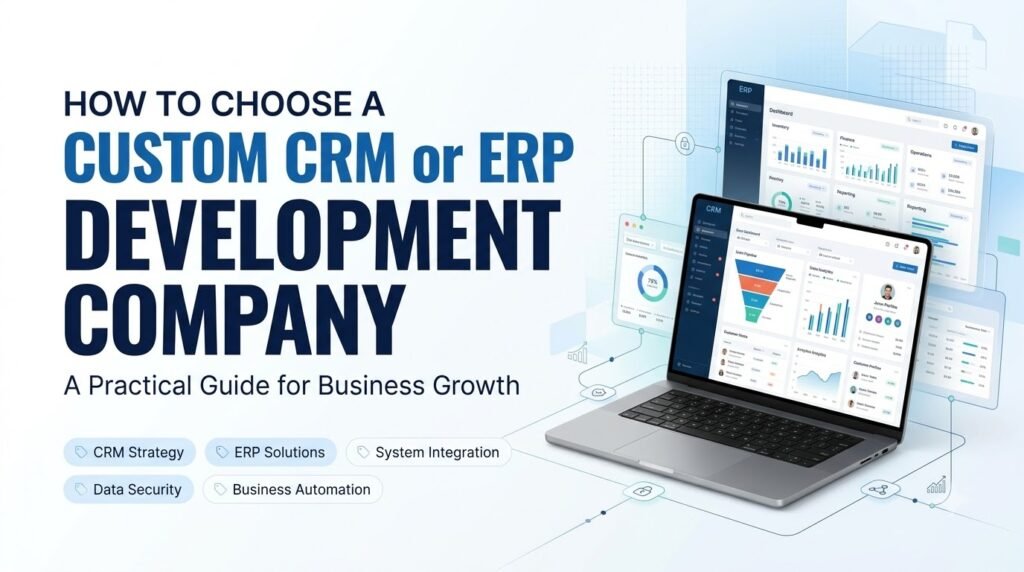





Businesses rely on connected systems to manage customer relationships, streamline internal operations and make informed decisions. However, as organisations grow, standard software does not always accommodate their workflows, reporting requirements or integration needs. This is why choosing the right custom CRM and ERP development company has become an important decision for businesses seeking greater operational control and long-term flexibility.
A customer relationship management (CRM) system helps businesses manage leads, sales activities and customer interactions, while an enterprise resource planning (ERP) system connects essential business functions such as finance, inventory, procurement and operations. Although ready-made platforms can be suitable for many organisations, businesses with specialised processes may require software designed around the way they actually work.
The challenge is not simply finding a company that can write code. It is finding a technology partner that understands your business objectives, recommends an appropriate technical approach and can support the software throughout its lifecycle.
This guide explains how to evaluate development partners, compare their capabilities and make a more informed investment in custom business software.
1. Understand Your Business Requirements Before Choosing a Company
Before approaching a software development company, identify the operational problems you want to solve. A clear understanding of your requirements helps you evaluate proposals more accurately and prevents unnecessary features from increasing the project budget.
Identify existing workflow problems
Start by examining how your teams currently manage information and complete routine tasks. You may be using spreadsheets to track sales opportunities, separate tools for inventory and accounting, or manual processes to generate management reports.
These arrangements can create duplicated records, inconsistent information, unnecessary administrative work and delays in decision-making.
Document the most significant problems and identify which processes would benefit most from automation. For example, a growing sales organisation might need a centralised lead management system, while a distribution business may require real-time inventory visibility across multiple locations.
Define essential features and integrations
Separate your requirements into three categories:
- Essential features: Functions the software must provide at launch, such as customer records, order management or financial reporting.
- Future enhancements: Capabilities that can be introduced in later development phases.
- Integrations: Connections with accounting platforms, payment gateways, websites, marketing tools or other existing applications.
Also consider user roles, reporting requirements, data migration and the number of employees who will use the system.
A well-defined scope gives a development partner a clearer foundation for estimating costs, identifying technical dependencies and recommending priorities. It also reduces the risk of paying for features that do not contribute meaningfully to business objectives.
2. Evaluate the Company’s Industry Experience and Technical Expertise
A development company may have strong programming skills but limited experience translating complex business processes into reliable software. Evaluating both technical expertise and practical business understanding is therefore essential.
Review relevant projects and case studies
Ask prospective partners to demonstrate previous work involving customised CRM platforms, ERP systems or similar enterprise applications. Focus on projects that share characteristics with your business, such as complex approval workflows, multiple departments, extensive integrations or large volumes of operational data.
When reviewing a portfolio, look beyond the visual interface. Ask how the software addressed the original problem, which challenges emerged during development and how the final solution supported the intended workflow.
If a company cannot disclose confidential project details, it may still be able to provide anonymised case studies or explain its technical approach without identifying the client.
Assess their technical capabilities
Depending on your requirements, the project may involve web application development, database architecture, API integrations, cloud infrastructure, automated testing and reporting tools.
A reliable partner should explain why its proposed technologies are appropriate rather than recommending a particular framework simply because it is familiar to the development team.
You should also establish whether the company has the skills to maintain the application after launch. Software architecture, documentation, testing practices and knowledge transfer can influence how easily the system can be updated as your business changes.
Practical tip: Request a technical walkthrough of a comparable project and ask the team to explain its architecture, integration strategy and approach to future upgrades. The quality of those explanations can reveal more than a portfolio screenshot.
3. Assess Their Custom CRM Software Development Capabilities
CRM software is most useful when it reflects the way a business attracts prospects, manages relationships, converts opportunities and supports customers. Generic sales pipelines may not suit organisations with specialised sales cycles, multiple approval stages or complex customer service requirements.
Custom CRM software development allows businesses to configure functionality around their actual sales and customer management processes.
Evaluate the CRM features your business needs
Depending on the organisation, a tailored CRM may include:
- Lead and opportunity management: Capture enquiries, assign leads, track sales stages and monitor conversion rates.
- Customer data management: Maintain organised customer profiles, communication histories and relevant account information.
- Sales automation: Automate follow-up reminders, task assignments, notifications and routine administrative activities.
- Customer support: Track service requests, manage response workflows and maintain a record of customer issues.
- Reporting and analytics: Monitor sales performance, pipeline value, customer activity and team productivity.
Not every organisation requires every feature. A startup may initially need lead tracking, contact management and basic sales reporting. A larger organisation might require territory-based sales workflows, role-specific dashboards and integration with customer support systems.
Look for workflow flexibility and useful reporting
A suitable development partner should understand how CRM functionality connects with your commercial objectives. For example, a sales manager may need to identify stalled opportunities, while a customer success team may need visibility into service history and renewal dates.
The company should be able to translate these requirements into practical workflows and reports rather than simply reproducing a standard CRM interface.
It should also explain how customer information will be validated, who can access sensitive records and how duplicate data will be managed.
The objective is to build a system that helps employees work more effectively while giving management a dependable view of customer activity.
4. Review Their Custom ERP Development Services
ERP systems bring business functions together within a connected operational environment. Unlike a CRM, which primarily focuses on customer relationships, an ERP typically supports a broader range of internal processes.
Custom ERP development services can help organisations connect departments that currently operate through disconnected applications or manual workflows.
Identify the ERP modules relevant to your operations
Depending on the business model, an ERP solution may include:
- Inventory management: Stock levels, warehouse movements, product tracking and replenishment.
- Finance and accounting: Financial reporting, expense tracking, invoicing and budget monitoring.
- Procurement: Supplier records, purchase requests, approvals and purchase order management.
- Human resources: Employee records, leave management and selected workforce administration processes.
- Supply chain operations: Order processing, fulfilment, logistics coordination and supplier visibility.
- Management reporting: Consolidated information across departments for operational and financial analysis.
A manufacturer, for instance, may need production planning and material tracking, while a professional services business may prioritise project costing, resource allocation and invoicing.
The development partner should understand these differences before proposing an architecture or selecting modules.
Check how the system connects departments
An ERP delivers value when information can move between departments without unnecessary manual re-entry. A confirmed sales order, for example, may need to update inventory, trigger fulfilment activities and provide the finance team with the information required for invoicing.
Ask the company how it will manage shared data, business rules, permissions and reporting across these workflows.
It is also worth discussing phased implementation. Deploying every module at once can create operational disruption, particularly when multiple departments must change their working practices simultaneously.
A phased approach allows the business to prioritise essential functions, test the system in realistic conditions and introduce additional capabilities as the organisation becomes ready.
5. Check Their Development Process and Communication
Even a technically capable team can struggle to deliver a successful project without a clear process and consistent communication. Before signing a contract, understand how the company will take your project from initial discovery to launch.
Review each stage of development
A structured development process generally includes the following stages:
Discovery and requirement analysis: The team studies your workflows, business objectives, users and existing technology.
Planning and solution design: Requirements are prioritised, the project scope is documented, and the technical architecture and delivery milestones are defined.
UI/UX design: The team develops user journeys, wireframes and interface designs that make the system practical for its intended users.
Development and integration: Developers build the agreed functionality, connect relevant applications and implement business rules.
Testing and quality assurance: The application is tested for functionality, security, performance, integration reliability and usability.
Deployment and training: The system is prepared for production, data is migrated where required, and users receive appropriate training.
Maintenance and improvement: The team addresses defects, applies updates and helps the software evolve as requirements change.
The precise process will vary with project complexity, but each stage should have clear responsibilities and acceptance criteria.
Assess project management and transparency
Ask how the company tracks progress, reports risks and handles decisions that require your input. Regular demonstrations, documented milestones and accessible project records make it easier to identify issues before they affect delivery.
You should also know who will serve as your primary contact and how quickly the team typically responds to project questions.
Business stakeholders must remain involved throughout development. Sales, finance, operations and IT teams may have different expectations, and their feedback is important when validating requirements and testing workflows.
A reliable partner makes this collaboration part of the process rather than waiting until the software is almost complete to request feedback.
6. Evaluate Security, Scalability and Integration Capabilities
CRM and ERP applications often contain sensitive customer information, financial records, employee details and commercially important operational data. Security and long-term maintainability should therefore be evaluated before development begins.
Understand the security approach
Ask how the company will protect information during storage, transmission and access. Depending on the project, relevant controls may include:
- Role-based access permissions and least-privilege access.
- Secure authentication and appropriate session management.
- Encryption for sensitive data in transit and, where appropriate, at rest.
- Regular backups and tested recovery procedures.
- Security testing, dependency updates and vulnerability remediation.
- Audit logs for important administrative and business activities.
Your development partner should also discuss relevant privacy obligations, data retention requirements and any industry-specific compliance needs that apply to your organisation.
Security responsibilities must be clearly allocated. Building secure software is important, but ongoing patching, access reviews, infrastructure configuration and employee practices also influence the overall risk.
Plan for future business growth
A system that works for a small team today may struggle if transaction volumes, user numbers or reporting demands increase significantly.
Ask how the proposed architecture will accommodate additional users, new locations, more complex workflows and future modules. Discuss performance testing, database design, monitoring and the practical cost of scaling the infrastructure.
Scalability does not necessarily mean building a highly complex system from day one. It means making sensible architectural decisions that support realistic growth without unnecessary expense.
Examine integration requirements
Your custom software may need to communicate with accounting platforms, payment systems, ecommerce websites, marketing applications or external logistics providers.
Ask whether the company has experience with APIs, webhooks, data synchronisation, authentication and integration error handling.
It should explain what happens when an external service becomes unavailable, an API changes or a transaction fails. Reliable integration requires more than establishing an initial connection; it also requires monitoring, error handling and a clear recovery process.
7. Compare Pricing, Timelines and Long-Term Support
Cost is an important consideration, but the lowest initial quotation does not always represent the best long-term investment.
A more useful comparison considers the total cost of ownership: the initial build, hosting, third-party licences, integrations, training, maintenance, upgrades and future enhancements.
Understand what the quotation includes
Ask each company to provide a written estimate covering the agreed scope, deliverables, assumptions, exclusions and payment milestones.
Clarify how additional requirements will be priced, who approves changes and how those changes might affect the timeline. Without a defined change-control process, even a reasonable project can become difficult to manage financially.
Timelines should also reflect the complexity of the system, data migration, third-party dependencies and stakeholder availability. Be cautious of proposals that promise unusually rapid delivery without first understanding your requirements.
Compare long-term support arrangements
Before choosing a partner, establish what happens after launch. Find out whether the agreement includes a warranty period, defect correction, technical assistance, monitoring, backups or ongoing maintenance.
Also clarify support hours, response commitments, escalation procedures and whether maintenance is charged separately.
A clear support arrangement helps you budget for the software’s continuing needs and reduces uncertainty when something goes wrong.
The strongest proposal is not necessarily the cheapest or the most feature-rich. It is the one that offers a realistic balance of scope, quality, cost, delivery risk and long-term maintainability.
8. Review Client Testimonials, Case Studies and Project Ownership
Trust should be supported by evidence. Before making a final decision, investigate the company’s reputation and establish what you will own when the project is complete.
Verify references and previous outcomes
Review client testimonials, independent feedback and relevant case studies. Where possible, ask for a reference from a client who has commissioned a project of similar complexity.
Useful questions include whether the company communicated consistently, handled changes professionally, met agreed acceptance criteria and provided support after launch.
Look for specific evidence rather than relying exclusively on broad claims about quality or customer satisfaction. A documented explanation of how a problem was addressed is more informative than an unsupported promise of exceptional results.
Clarify source code and intellectual property rights
The contract should explain ownership and permitted use of the software, including custom-developed source code, designs, documentation and other project deliverables.
It should also distinguish bespoke work from pre-existing frameworks, third-party libraries and licensed components, which may be subject to separate terms.
Confirm whether your team will receive access to source code repositories, deployment instructions, database documentation and relevant configuration details. Clarify whether the software can be maintained by another provider if the relationship ends.
For cloud-hosted applications, establish who controls the hosting account, domain, credentials, backups and production environment.
These arrangements should be documented before development begins, not negotiated for the first time when you need to change vendors.
9. Questions to Ask Before Hiring a CRM or ERP Development Company
Use the following questions during vendor discussions to compare potential partners consistently.
- Have you developed similar custom business software before? Ask for relevant examples and an explanation of the business problems they addressed.
- How do you understand and document our requirements? Look for a discovery process, documented workflows and clear acceptance criteria.
- Which technologies and integrations do you recommend, and why? The answer should relate to your needs, existing systems and future plans.
- How do you handle data security and scalability? Ask about access controls, testing, backups, monitoring and architectural decisions.
- What happens if our requirements change during development? Confirm how changes are assessed, approved, priced and scheduled.
- What post-launch support and maintenance do you provide? Establish the scope of support, response commitments and ongoing costs.
- Who owns the source code and intellectual property? Make sure ownership, licences, repository access and handover obligations are covered in the contract.
Compare the answers against your priorities rather than treating every vendor’s proposal as equivalent. A partner that identifies risks early and explains trade-offs clearly may be a better choice than one that agrees to every request without discussing feasibility.
10. Why Choose Ambient Infotech for Custom Business Software Development?
Choosing a development partner involves finding a company that can connect technical decisions with practical business needs. Ambient Infotech provides web development, software solutions, ERP and CRM-related capabilities as part of its broader technology offering.
For businesses evaluating a custom CRM and ERP development company, the important consideration is whether the proposed team can understand the organisation’s workflows, define an appropriate solution and establish a clear delivery and support plan.
A business-focused approach to software planning
A custom business application should begin with an understanding of operational challenges rather than a predetermined list of features.
Ambient Infotech can be considered for discussions around business software requirements, workflow-specific functionality, application integrations and the technical planning needed to support evolving operational demands. The appropriate project scope should be established through a detailed assessment of the business’s existing systems and objectives.
Functionality aligned with your processes
Different organisations need different capabilities. A CRM project may focus on lead management, sales automation and customer records, while an ERP project may centre on inventory, procurement, finance or departmental reporting.
The proposed solution should reflect these priorities and distinguish essential launch features from later enhancements. This helps businesses focus their investment on functionality that addresses actual operational requirements.
Integration and long-term planning
Custom software rarely operates in isolation. Integration planning, data migration, access permissions and maintenance requirements should be considered alongside the core application.
When evaluating Ambient Infotech or any prospective partner, discuss the proposed architecture, project milestones, security responsibilities, ownership terms and post-launch support arrangements before committing to the project.
Visit Ambient Infotech to explore its technology offering and discuss whether its capabilities align with your business software requirements.
The final decision should be based on the suitability of the proposed solution, the expertise of the assigned team, transparent commercial terms and a clear understanding of responsibilities throughout the software lifecycle.
Conclusion
Choosing a reliable custom CRM or ERP development company requires more than comparing quotations or reviewing attractive portfolios. Businesses need to evaluate technical expertise, industry experience, requirement analysis, communication, security, integration capabilities and long-term support together.
Start by documenting your operational challenges and defining the outcomes you expect from the software. Then assess prospective partners against those requirements, verify their experience, clarify ownership and compare the total cost of ownership rather than the initial development fee alone.
Whether you need Custom CRM software development to improve customer management or Custom ERP development services to connect internal operations, the right partner should be able to explain how its proposed solution will address your requirements and adapt as your organisation grows.
Ambient Infotech is one option to consider when exploring custom business software solutions. Take the time to discuss your needs, evaluate the proposed approach and establish clear expectations before moving forward.
Ultimately, the best technology partnership is one built on business understanding, technical competence, transparent communication and a shared commitment to creating software that supports your organisation’s long-term objectives.