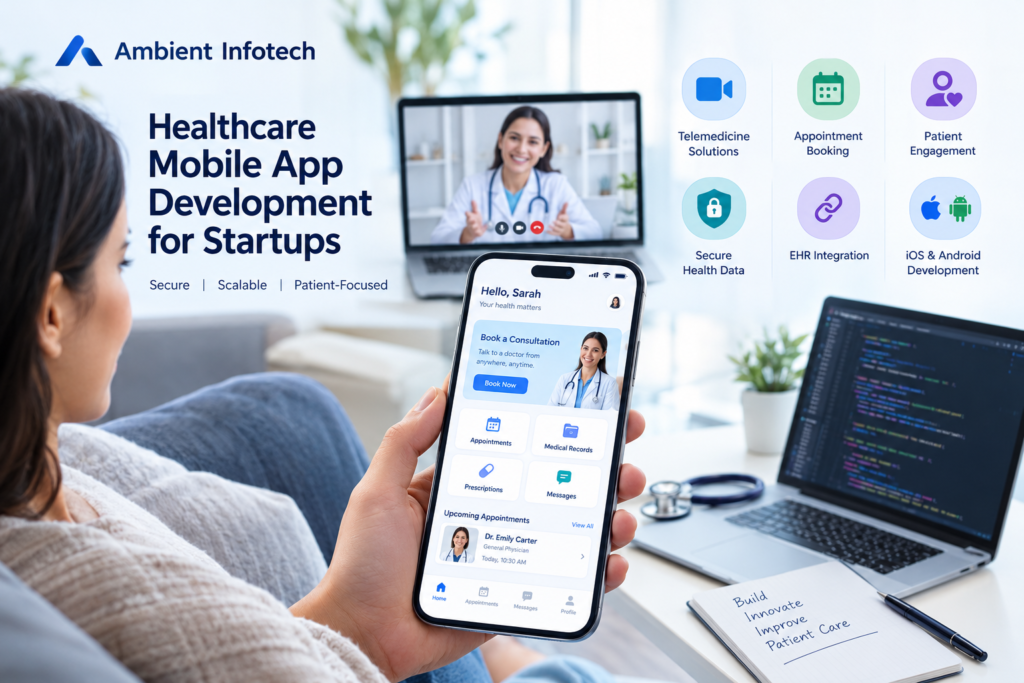





Healthcare startups are entering a digital environment where patients expect convenient access to medical services, secure communication with healthcare professionals, and simpler ways to manage appointments and health information. However, building a healthcare application involves considerably more than creating an attractive interface. Developers must account for sensitive patient data, clinical workflows, system integrations, accessibility, and regulatory requirements that vary across markets.
Working with Healthcare mobile app developers for startups can help founders turn an initial concept into a practical, secure, and scalable digital product. Whether the business is developing a telemedicine platform, a patient engagement application, a remote monitoring solution, or a digital clinic service, specialist knowledge can make a meaningful difference to the development process.
For startups targeting the United Arab Emirates (UAE), the United Kingdom, Australia, and other international markets, early technical decisions can influence product reliability, operating costs, and future expansion. A suitable development partner helps align technology with the startup’s business model, intended users, and regulatory environment.
Why Healthcare Startups Have Unique Mobile App Development Needs
Healthcare applications operate in an environment where privacy, reliability, and usability are essential. A general consumer app might focus primarily on convenience and engagement, but a healthcare product may also handle sensitive medical information, coordinate appointments, facilitate communication between patients and clinicians, or connect with existing healthcare infrastructure.
These responsibilities introduce several challenges that founders should consider before development begins.
Protecting Sensitive Patient Information
Healthcare applications may collect personal details, medical histories, appointment records, prescription information, consultation notes, and monitoring data. If this information is exposed, altered, or accessed by unauthorised individuals, the consequences can extend beyond financial or reputational damage.
Startups need a clear approach to data collection, storage, access permissions, encryption, and retention. Developers should also consider how the application handles password recovery, session management, account deletion, and access from shared devices.
Supporting Real Healthcare Workflows
A healthcare application must reflect how its intended users actually work. A telemedicine platform, for example, may need to manage consultation requests, clinician availability, appointment confirmations, video sessions, and follow-up communication.
A clinic booking application has different requirements, including practitioner schedules, appointment changes, cancellations, and administrative oversight. Developers who understand these workflows can help identify operational gaps before they become expensive changes.
Delivering Accessible and Reliable Experiences
Patients may use healthcare applications across different devices, network conditions, languages, and levels of digital confidence. Interfaces should therefore be straightforward, readable, accessible, and predictable.
The application must also handle practical problems such as failed payments, missed notifications, interrupted video calls, and temporary connectivity loss. Clear error messages and sensible recovery options can help users understand what to do next.
Connecting With Existing Systems
Startups may need to integrate their applications with electronic health record systems, practice management software, payment gateways, laboratory platforms, or remote monitoring services. Each integration introduces technical and operational considerations, including data mapping, authentication, permissions, and compatibility.
Planning these requirements early helps prevent a situation in which the mobile application works independently but cannot support the wider healthcare service.
How Specialized Healthcare Mobile App Developers Help Startups
Choosing experienced Healthcare mobile app developers for startups can help founders make informed decisions across product planning, design, implementation, testing, and maintenance. Specialist experience does not guarantee success, but it can help teams identify risks and avoid preventable technical problems.
Healthcare Workflow Analysis and Technical Planning
Development should begin with a clear understanding of the service being offered. A startup needs to identify its users, the problems it intends to solve, and the tasks the application must support.
For example, a virtual consultation platform may require separate workflows for patients, healthcare professionals, and administrators. Each role needs appropriate permissions and a clearly defined set of actions.
A development team can translate these requirements into user journeys, technical specifications, system architecture, and a realistic development roadmap.
Patient-Focused UI/UX Design
Medical app UX design should prioritise clarity over unnecessary complexity. Patients need to understand how to book appointments, join consultations, access authorised information, and contact the relevant service.
A specialist team can use wireframes, interactive prototypes, usability testing, and accessibility reviews to evaluate the experience before committing to full development.
Secure Authentication and Access Controls
Not every user should have access to every record or function. Role-based access controls can help restrict information according to a user’s responsibilities, while secure authentication helps protect accounts.
Depending on the product, additional safeguards may include multi-factor authentication, session expiry, audit logs, and monitoring for suspicious activity. These controls should be selected according to the application’s risk profile and applicable requirements.
Integration, Testing, and Ongoing Support
Healthcare applications often depend on external platforms and services. Developers need to plan for integration failures, API changes, interrupted connections, and inconsistent data.
Specialised testing can examine functionality, performance, permissions, accessibility, and security. After launch, healthcare app maintenance and support help address vulnerabilities, operating system updates, changing dependencies, and new business requirements.
Essential Features for a Healthcare Startup Mobile App
The right features depend on the startup’s business model, users, and operational needs. A telemedicine business will require different functionality from a clinic booking service or a remote patient monitoring platform.
Common features include:
-
Patient registration and profile management: Allow users to create accounts and maintain relevant personal information with appropriate safeguards.
-
Appointment booking and reminders: Display availability, support scheduling changes, and send useful reminders.
-
Secure messaging: Enable appropriate communication between patients and authorised healthcare professionals.
-
Video consultations: Support remote appointments through an integrated or purpose-built video service.
-
Health information access: Let authorised users view relevant medical records or test results where the system and permissions allow.
-
Digital prescriptions: Support prescription workflows where legally and operationally appropriate.
-
Payments and billing: Manage consultation fees, invoices, and payment confirmations securely.
-
Notifications and follow-ups: Provide appointment updates, reminders, and service-related messages based on user preferences and consent.
-
Administrative dashboards: Help authorised staff manage appointments, user access, service activity, and operational reports.
These capabilities should not all be treated as mandatory for the first release.
Start With a Minimum Viable Product
A minimum viable product (MVP) focuses on the essential features needed to test a product’s core value. A startup launching an appointment booking service might initially need account registration, practitioner availability, booking management, reminders, and an administrative dashboard.
Video consultations, complex reporting, wearable integrations, and advanced automation could follow once the core service has been tested and the business has gathered meaningful feedback.
This approach can help control scope, make spending more predictable, and reduce the risk of building features that users do not need. However, essential security, privacy, accessibility, and regulatory considerations must be addressed from the beginning rather than postponed as optional enhancements.
The Role of Healthcare App Development Services in Startup Growth
Reliable Healthcare app development services should support the entire journey from an early idea to a working application and its ongoing improvement. A structured process helps founders understand what they are building, why each feature matters, and how the product will be maintained after launch.
1. Discovery and Requirements Gathering
The first stage involves defining the business model, target users, core problems, and operational requirements. Developers should identify whether the application serves patients, healthcare professionals, clinics, or multiple user groups.
The team should also document expected integrations, privacy requirements, accessibility needs, and the technical constraints that may affect the project.
2. Research, UX Design, and Prototyping
User research helps uncover how patients and healthcare professionals expect to interact with the service. Wireframes and prototypes allow the team to evaluate navigation, booking flows, consent screens, and other important interactions before full implementation.
This stage can reveal usability problems while changes are still relatively straightforward to make.
3. MVP Development and Backend Architecture
Once the scope is agreed, developers build the mobile interface, backend services, databases, and APIs required by the application. The architecture should reflect the product’s expected workload, security requirements, integration needs, and future expansion plans.
A startup should avoid both unnecessary complexity and shortcuts that could make the product difficult to maintain.
4. Integration, Quality Assurance, and Security Testing
Before release, the team should test the application across supported devices and operating system versions. Testing should cover core workflows, account permissions, data handling, notifications, integrations, performance, and error recovery.
Security testing and any required regulatory assessments should be planned according to the product’s risks and intended markets.
5. Deployment and Continuous Improvement
Launching the application is the beginning of an ongoing product lifecycle. Startups need a process for collecting feedback, monitoring technical issues, reviewing usage patterns, applying security updates, and prioritising improvements.
A clear development process helps founders manage scope and spending while making evidence-based decisions about future features.
Why iOS and Android Healthcare App Development Matters
The choice of mobile platform affects the user experience, development budget, integrations, and long-term maintenance requirements. iOS and Android healthcare app development should therefore be planned around the startup’s target audience and product objectives rather than selected solely on cost.
Native Development Versus Cross-Platform Development
Native development uses platform-specific technologies to build separate applications for iOS and Android. This approach can be appropriate when a product requires extensive device integration, specialised performance, or platform-specific capabilities.
Cross-platform development allows a team to share a substantial portion of its code across platforms. It may reduce duplicated development work and help a startup deliver consistent functionality to a wider audience.
Neither approach is universally better. The decision depends on factors such as:
-
Required device features and third-party SDK compatibility.
-
Integration with healthcare systems and connected devices.
-
Development resources and delivery priorities.
-
Performance, accessibility, and user experience requirements.
-
Maintenance costs and the expected product roadmap.
A healthcare application that connects to wearable devices or relies on particular device permissions may need more detailed technical evaluation before the architecture is chosen.
Consistency, Accessibility, and App Store Readiness
Patients should be able to navigate the application consistently across supported devices. Developers need to consider readable text, clear navigation, appropriate touch targets, accessible forms, and interfaces that adapt to different screen sizes.
Secure authentication, carefully managed push notifications, and device permission handling are also important. Before launch, the team should prepare for app store review requirements and ongoing compatibility updates.
The goal is not simply to publish an app on both platforms. It is to deliver a dependable experience that supports the intended healthcare service.
Healthcare App Development UAE: Opportunities and Considerations
The UAE offers opportunities for digital health businesses serving patients, clinics, healthcare professionals, and medical service providers. Applications can support appointment scheduling, virtual consultations, patient communication, and access to authorised health information.
For startups exploring Healthcare app development UAE, the technical plan should reflect local operational requirements as well as the needs of the intended audience.
Designing for UAE Healthcare Users
A healthcare application may benefit from Arabic and English language support, depending on its target users. Language selection should be considered alongside accessibility, clear medical terminology, readable layouts, and support for right-to-left interfaces where Arabic is provided.
For example, a clinic network serving patients across different locations may need appointment booking, practitioner availability, reminders, and administrative tools. A telemedicine provider may additionally require video consultation functionality, appropriate identity checks, and secure communication.
The design should reflect how the service operates rather than assuming that every healthcare provider has identical workflows.
Local Integrations and Regulatory Planning
Integration requirements depend on the healthcare providers and platforms involved. Before committing to a particular architecture, startups should establish which systems are available, what permissions are required, and whether the necessary APIs or interoperability arrangements can be accessed.
Data protection and healthcare regulation also require careful consideration. The UAE’s federal Personal Data Protection Law, relevant healthcare legislation, and applicable emirate-level requirements may affect how an application collects, processes, stores, and transfers personal or health information. The precise obligations depend on the organisation, service, location, and data processing arrangements.
Startups should obtain qualified local legal and regulatory advice before launch. Developing an application for the UAE market does not, by itself, establish compliance with local law.
Protecting Patient Data and Meeting Healthcare Security Requirements
Healthcare data security should be built into the application from the planning stage. Adding basic security features after development may leave architectural weaknesses that are more expensive to correct.
A suitable security approach considers the entire information lifecycle, from collection and transmission to storage, access, retention, and deletion.
Important safeguards include:
-
Encryption: Protect data in transit and at rest using appropriate, securely managed encryption.
-
Authentication and access controls: Verify users and restrict sensitive information according to their authorised roles.
-
Audit logging: Maintain suitable records of important actions and access to sensitive information.
-
Secure APIs: Apply authentication, authorisation, input validation, and appropriate rate limits to system integrations.
-
Consent and data minimisation: Collect only the information needed for defined purposes and manage consent where required.
-
Backups and recovery: Plan for data restoration, service interruptions, and incident response.
-
Third-party assessments: Review vendors, cloud services, analytics tools, and SDKs that may process sensitive information.
-
Ongoing security testing: Address vulnerabilities, update dependencies, and reassess risks as the application evolves.
Understanding HIPAA and Other Applicable Requirements
In the United States, the Health Insurance Portability and Accountability Act (HIPAA) applies to covered entities and business associates within its scope. A healthcare app is not automatically subject to HIPAA simply because it handles health-related information; the organisation’s role, relationships, and activities matter.
Other laws and requirements may apply depending on the location and nature of the service. UK operations, for example, may involve UK data protection legislation, while UAE operations require assessment of relevant UAE privacy and healthcare rules.
Specialist developers can help implement appropriate technical controls and documentation, but compliance also depends on organisational policies, contracts, operational procedures, and legal responsibilities. No individual technology stack or security feature guarantees regulatory compliance.
Integrating Healthcare Apps With Existing Systems
A mobile application rarely operates in isolation for long. Healthcare startups may need to connect it with existing clinical, administrative, and payment infrastructure to support a complete service.
Common integration requirements include electronic health records (EHRs), electronic medical records (EMRs), practice management platforms, scheduling systems, payment gateways, video consultation providers, laboratories, diagnostic services, and wearable devices.
These connections can introduce challenges involving incompatible data formats, different authentication methods, inconsistent patient identifiers, and varying levels of system access.
Why Interoperability Matters
Developers should examine the integration capabilities of each external platform before choosing an implementation approach. Secure APIs, carefully mapped data fields, appropriate access permissions, and thorough integration testing help reduce the risk of information being transferred incorrectly or exposed unnecessarily.
HL7 FHIR is one interoperability standard that may be relevant when exchanging healthcare information between compatible systems. Its suitability depends on the systems involved, available implementation guides, and the data being exchanged.
For example, a remote patient monitoring application may need to receive readings from a connected device, associate them with the correct authorised patient record, and display the information to an appropriate user. Each step requires validation and a clear understanding of the responsibilities of the connected systems.
Planning integrations early can help prevent costly redesign and improve the application’s ability to fit into existing healthcare operations.
How Healthcare Startups Can Manage Development Costs
Healthcare mobile app development costs vary considerably. The budget depends on the application’s complexity, development approach, required integrations, security controls, testing scope, and ongoing operational needs.
A straightforward appointment booking MVP will generally involve different requirements from a multi-provider telemedicine platform with medical records, payments, video consultations, and remote monitoring.
Startups can make more informed budget decisions by defining their initial requirements before requesting development estimates.
Prioritise Features and Define Scope
Separate essential launch functionality from features that can be introduced later. Document the main user journeys, integration requirements, acceptance criteria, and security expectations.
This gives development teams a clearer basis for estimating effort and helps founders compare proposals more fairly.
Account for Costs Beyond Initial Development
The initial quotation is only one part of the financial picture. Budgets may also need to cover cloud hosting, third-party service subscriptions, security assessments, regulatory advice, app store administration, monitoring, maintenance, and future enhancements.
The lowest initial quotation may not represent the lowest total cost if it excludes necessary testing, documentation, secure infrastructure, or post-launch support.
An MVP can help control initial investment, but it should not be used to justify omitting essential safeguards. A practical budget should balance launch priorities with the technical and operational requirements of a responsible healthcare service.
How to Choose the Right Healthcare App Development Partner
Selecting a development company requires more than comparing proposals or reviewing app designs. Founders should evaluate whether a team can understand the healthcare service, manage technical risks, and support the application after launch.
Look for evidence of secure mobile development, relevant workflow experience, API integration expertise, and a structured approach to testing. Ask for verifiable portfolio examples that demonstrate comparable technical challenges, while respecting client confidentiality.
Before signing a contract, clarify source code ownership, intellectual property rights, documentation, access to development environments, third-party licences, and responsibilities for maintenance.
It is also worth asking potential partners:
-
Have you developed applications with workflows similar to ours?
-
How do you protect sensitive patient information?
-
How will you approach integrations with existing healthcare systems?
-
Which mobile architecture best suits our requirements, and why?
-
What functional, accessibility, and security testing is included?
-
How will the application accommodate increased usage and new features?
-
What maintenance, incident support, and updates are available after launch?
A suitable partner should explain technical trade-offs clearly rather than promise that every requirement can be delivered without constraints. The team should understand both the software and the environment in which healthcare professionals and patients will use it.
How Ambient Infotech Can Support Healthcare Startup Projects
Ambient Infotech is a software development company that healthcare startups can evaluate when planning a mobile application or a broader digital platform. The appropriate project scope depends on the company’s verified capabilities and the startup’s specific requirements.
Potential areas of support include custom mobile application development, web platforms, backend services, workflow automation, and third-party integrations where these services match the project’s needs.
For a startup building a patient-facing application, the development process can begin with requirements analysis, user journey planning, platform selection, and a defined MVP scope. The technical team can then establish the required architecture, identify integration dependencies, and plan functional testing and ongoing maintenance.
For businesses exploring the UAE market, the project plan should also account for local language needs, the intended healthcare providers, data processing arrangements, and applicable regulatory obligations. Qualified local advisers should be involved where legal or regulatory interpretation is required.
When evaluating Ambient Infotech or another development partner, founders should confirm relevant project experience, security practices, contractual terms, and post-launch support arrangements. A well-defined working relationship helps ensure that the final product reflects the startup’s operational priorities and long-term goals.
Conclusion
Healthcare startups need more than developers who can build a mobile interface. They need a development approach that accounts for healthcare workflows, patient privacy, accessibility, secure integrations, platform compatibility, and ongoing maintenance.
Working with specialised Healthcare mobile app developers for startups can help founders identify technical risks early, prioritise essential features, and build a foundation for future growth. A carefully planned MVP, an appropriate mobile architecture, and a realistic development budget can make the journey from concept to launch more manageable.
Whether the goal is a telemedicine platform, a healthcare appointment booking app, a patient portal, or a remote monitoring solution, the most important decisions should be driven by user needs, operational realities, and applicable legal requirements.
Start by defining the problem your application will solve, identifying its essential features, and evaluating development partners against clear technical and business criteria. With the right planning and continued support, a healthcare startup can build a digital product designed to serve its users reliably as the business evolves.