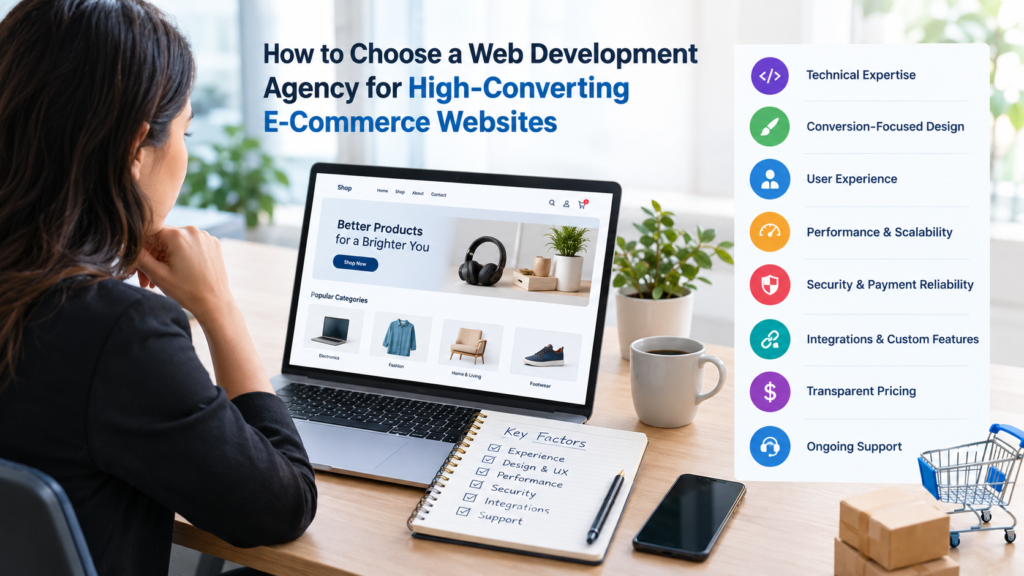





Choosing the right agency for high-converting e-commerce website development involves much more than comparing designs and development prices. Your online store needs to attract relevant visitors, help shoppers find suitable products, provide a smooth checkout experience, and establish trust at every stage of the buying journey. The right development partner should understand these requirements and translate them into a website that supports your business objectives.
Whether you are launching a new online store, redesigning an existing platform, or addressing declining sales, evaluate agencies based on their technical expertise, conversion-focused design, user experience, performance, security, integrations, and ongoing support. A well-planned store can remove unnecessary friction and make purchasing easier, although actual sales depend on factors such as product quality, pricing, marketing, and customer demand.
This guide explains how to assess an agency, compare proposals, and select a partner capable of supporting your e-commerce business as it grows.
Why Your Choice of E-Commerce Development Agency Matters
An agency’s decisions influence how customers discover products, evaluate options, and complete purchases. Poor navigation, slow pages, confusing checkout steps, or unexpected delivery costs can discourage shoppers even when the products meet their needs.
A capable agency considers the complete shopping journey, including:
-
Website usability and customer confidence: Clear layouts, accessible information, and consistent branding help visitors understand your business.
-
Product discovery: Logical categories, useful search tools, and relevant filters make product selection easier.
-
Mobile shopping: Responsive layouts and touch-friendly controls support customers browsing on smartphones.
-
Performance: Efficient pages reduce unnecessary waiting and improve the overall experience.
-
Checkout completion: Straightforward forms, transparent costs, and suitable payment options remove avoidable obstacles.
-
Security: Properly configured payment integrations and appropriate data protection practices help establish trust.
-
Scalability: A suitable technical foundation can accommodate expanding product ranges, integrations, and order volumes.
However, development alone cannot guarantee higher conversions. Product-market fit, traffic quality, stock availability, competitive pricing, merchandising, and customer service also influence purchasing decisions. Choose an agency that understands these dependencies rather than promising sales results it cannot control.
1. Look for Relevant E-Commerce Development Experience
An agency’s portfolio should demonstrate experience relevant to your business model, not simply an ability to produce attractive websites.
For example, a fashion retailer may need colour and size variations, product photography, stock synchronisation, and straightforward returns. A wholesale supplier might require customer-specific pricing, bulk ordering, quotation requests, and account-based purchasing.
Ask shortlisted agencies about their experience with:
-
Product catalogues, categories, variations, and inventory management.
-
Payment gateways, shipping providers, taxes, and delivery calculations.
-
Order processing, customer accounts, and returns workflows.
-
Subscription billing, wholesale purchasing, or marketplace functionality where required.
-
Third-party integrations and complex operational processes.
Review live stores and relevant case studies. Test important pages yourself, particularly product listings, product details, mobile navigation, and checkout.
Ask what the agency actually delivered, which technologies it used, and how it addressed project challenges. A website’s existence does not establish that the agency developed every feature or achieved particular business results.
2. Evaluate Their Approach to Conversion-Focused Website Design
Effective high-converting e-commerce website development starts with understanding customer intent. The website should make the next step obvious, whether a visitor is comparing products, checking delivery information, or preparing to purchase.
An agency should explain how it will organise page layouts, product information, navigation, and calls to action around your customers’ needs.
Product pages deserve particular attention. Useful descriptions, accurate specifications, clear pricing, high-quality images, availability information, and visible delivery or return policies help customers make informed decisions. Reviews and trust indicators can also be valuable when they are genuine and relevant.
The cart and checkout should maintain this clarity. Avoid unnecessary distractions, unexpected charges, and forms that request information without a clear purpose.
Ask the agency to explain its design decisions. Will it use customer research, existing analytics, competitor analysis, usability testing, or established design patterns? Can it provide wireframes or interactive prototypes before development begins?
Visual appeal matters, but design choices should also support usability and purchasing decisions. A distinctive website is useful only when customers can understand it and navigate it comfortably.
3. Assess Their E-commerce UX optimization Capabilities
E-commerce UX optimization focuses on identifying and reducing obstacles that prevent shoppers from completing their intended tasks. It should cover the entire journey, from finding a product to receiving confirmation of an order.
Important capabilities include intuitive category structures, relevant search results, useful filters, clear variant selection, readable content, accessible controls, and mobile-friendly interactions. The agency should also understand guest checkout, form simplification, helpful error messages, and appropriate payment options.
Consider a store where customers frequently leave during checkout. An experienced team might examine whether account creation is compulsory, delivery costs appear too late, address fields are unnecessarily complicated, or payment errors are difficult to resolve.
The team could then test targeted improvements and compare the results using reliable analytics.
Ask whether the agency conducts usability testing, reviews customer feedback, analyses funnel data, and validates changes before recommending a redesign. Accessibility should also be considered so customers with different needs can use the store more effectively.
The objective is not to add features indiscriminately. It is to make important tasks easier, reduce confusion, and give shoppers the information they need to proceed confidently.
4. Understand Their Technical Skills and Platform Expertise
The appropriate technology depends on your catalogue size, operational processes, budget, growth plans, and required integrations. A good agency explains the trade-offs instead of recommending the same platform for every client.
E-commerce website development may involve established platforms such as Shopify and WooCommerce, enterprise-oriented solutions such as Adobe Commerce (Magento), or a custom-built application.
Shopify can suit businesses seeking a managed commerce platform with an established ecosystem. WooCommerce offers flexibility for businesses already using WordPress. Adobe Commerce may be appropriate for complex catalogues and advanced business requirements, depending on implementation and operating costs. Custom platforms provide greater control but usually require more planning, development, testing, and maintenance.
Evaluate the agency’s knowledge of frontend and backend development, databases, APIs, payment gateways, inventory systems, shipping tools, and ERP or CRM integrations.
Also ask how third-party extensions are selected, updated, and maintained. An inexpensive plugin can introduce compatibility, security, or performance problems if it is poorly maintained.
The final recommendation should explain why a particular platform suits your business today and how it can accommodate foreseeable requirements without unnecessary complexity.
5. Check Website Speed, Mobile Performance, and Scalability
A store that loads slowly or behaves inconsistently on mobile devices can frustrate customers before they reach checkout. Your agency should treat performance as a development requirement rather than an optional improvement after launch.
Ask how the team plans to handle image compression, responsive image delivery, efficient scripts, caching, hosting configuration, and database performance. Unnecessary apps, oversized images, and poorly implemented integrations can all affect responsiveness.
The agency should also test the website across representative mobile devices, browsers, screen sizes, and network conditions. Google’s Core Web Vitals provide useful measures of loading performance, responsiveness, and visual stability. These metrics can help identify technical issues, but they should be considered alongside real user behaviour.
Scalability deserves similar attention. A growing store may need to handle larger product catalogues, seasonal traffic, additional sales channels, or more frequent inventory updates. The architecture and hosting arrangements should reflect these needs without paying for unnecessary infrastructure.
Before signing a contract, ask which performance indicators will be measured, how bottlenecks will be investigated, and whether monitoring is included after launch. Request an agreed testing plan instead of relying on vague promises about a fast website.
6. Review Their Customization and Integration Capabilities
Standard themes and extensions can meet many requirements, but some businesses need functionality that reflects their specific products or workflows.
Custom e-commerce website development may be appropriate when standard platform features cannot support essential requirements. Examples include product configurators, personalised product options, loyalty programmes, advanced filtering, wholesale pricing, multi-language storefronts, and specialised reporting.
Integration capabilities are equally important. Your store may need to exchange information with a CRM, ERP, accounting application, marketing automation platform, warehouse management system, or shipping provider.
For example, connecting inventory management with an online store can help synchronise stock information and reduce manual updates. However, the integration must define how conflicts, failed synchronisations, and unavailable services are handled.
Ask the agency to document the purpose, data flow, dependencies, and maintenance requirements of each custom feature. Confirm who will update integrations when third-party APIs change and how sensitive information will be protected.
Customisation should solve a genuine business problem. Unnecessary complexity can increase development costs and make future updates more difficult.
7. Evaluate SEO, Analytics, and Conversion Measurement
An e-commerce website should be discoverable by search engines and measurable from the beginning. Retrofitting SEO and analytics after launch can create avoidable technical work and leave important data gaps.
Ask the agency how it will implement:
-
Search-friendly URLs, logical site architecture, and descriptive headings.
-
Optimised product and category pages with relevant metadata.
-
Canonical URLs and appropriate handling of duplicate product variations.
-
Structured data where eligible and appropriate.
-
XML sitemaps, crawlability, redirects, and indexation checks.
-
Analytics configuration and e-commerce event tracking.
Measurement should reflect your business objectives. Depending on the store, useful events may include product views, searches, add-to-cart actions, checkout initiation, payment completion, and completed purchases.
A properly configured funnel can help reveal where shoppers leave the journey. For instance, many product views but few cart additions may justify investigating product information, pricing, or availability. High checkout abandonment may warrant examining delivery charges, form usability, or payment errors.
These patterns indicate areas to investigate rather than proving a particular cause. Agree on tracking requirements, access permissions, and reporting responsibilities before development starts.
8. Compare Pricing, Project Scope, and Deliverables
Comparing quotations becomes difficult when agencies define their services differently. One proposal might include product migration and testing, while another covers only the storefront and basic configuration.
Ask each agency to itemise its E-commerce development services and associated costs. The proposal should explain what is included, what is excluded, and which responsibilities remain with your team.
Review the following areas carefully:
-
Design, development, responsive templates, and required functionality.
-
Product and content migration, including redirects where necessary.
-
Payment, shipping, inventory, and marketing integrations.
-
Testing, launch preparation, training, and documentation.
-
Hosting, third-party subscriptions, licences, and recurring fees.
-
Payment milestones, approval stages, and change-request charges.
-
Warranty periods, maintenance arrangements, and support costs.
The lowest quotation is not necessarily the least expensive option over the life of the website. Missing functionality, unclear requirements, or inadequate testing may lead to additional costs later.
Request a written scope of work with acceptance criteria for key deliverables. If the project is likely to evolve, clarify how changes will be estimated, approved, and scheduled.
9. Verify Security, Payment Handling, and Quality Assurance
Customers need confidence that their information and transactions are handled appropriately. Security should therefore be built into the development process, not left until the final review.
Ask how the agency manages HTTPS, administrator permissions, software updates, dependency vulnerabilities, backups, recovery procedures, and security testing. Confirm how access credentials are stored and who can access production systems.
Payment processing deserves particular attention. Use an appropriate payment provider and integration that meet the requirements applicable to your business. Avoid storing sensitive payment details unnecessarily, and clarify which party is responsible for payment-related security and compliance obligations.
Quality assurance should cover more than whether the homepage looks correct. Request functional testing for product variations, stock availability, discount codes, shipping calculations, payment outcomes, order confirmation emails, and refund workflows where applicable.
The team should also perform cross-browser and device testing, regression testing after significant changes, and checks for integration failures.
For your protection, document security responsibilities, testing procedures, defect resolution, and launch approval requirements in the project agreement.
10. Check Communication and Post-Launch Support
A successful project requires clear communication throughout planning, development, testing, and launch. Before hiring an agency, understand how it gathers requirements, reports progress, manages feedback, and handles delays or changing priorities.
Ask who your main contact will be, how often you will receive updates, and how design approvals and technical decisions will be recorded. Defined milestones make it easier to identify issues before they affect the launch date.
Support after launch matters just as much. Online stores require ongoing updates, bug fixes, performance reviews, security maintenance, and occasional improvements as business requirements change.
Clarify whether support is provided through a retainer, an agreed number of hours, or a separate service agreement. Check response times, emergency procedures, and any exclusions.
Finally, establish ownership before work begins. Your contract should explain access to the domain, hosting, source code where applicable, platform accounts, analytics, content, design files, and relevant documentation. The business should retain the access and rights agreed in the contract, without unnecessary dependence on the agency.
Questions to Ask Before Hiring an E-Commerce Agency
Use these questions during discovery calls or proposal reviews:
-
Have you built e-commerce websites with requirements similar to ours?
-
Which platform would you recommend, and why?
-
How will you approach conversion-focused design and usability?
-
How will you test mobile performance and checkout functionality?
-
Which payment, shipping, inventory, and marketing integrations can you support?
-
How will SEO and analytics be handled during development?
-
What is included in the quotation, and what costs are additional?
-
Who will own the website, source code, and accounts?
-
What testing and security measures are included?
-
What maintenance and support do you provide after launch?
Look for specific, evidence-based answers. An agency should be able to explain its approach, identify potential risks, and acknowledge limitations. These discussions help you distinguish a team that understands your business requirements from one that simply offers a standard package.
A Practical Checklist for Choosing the Right Agency
Use the same criteria to assess every shortlisted agency. Mark each item as confirmed, needs clarification, or not included.
Agency evaluation checklist
Reset checklist
A completed checklist is a starting point, not a substitute for due diligence. Verify important claims, compare the quality of proposed solutions, and investigate unresolved issues before making a decision.
How Ambient Infotech Can Support Your E-Commerce Goals
Businesses evaluating an e-commerce development partner can consider Ambient Infotech alongside other agencies, using the same requirements, evidence, and evaluation criteria.
According to its official website, Ambient Infotech offers e-commerce development, Shopify development, WooCommerce development, and Adobe Commerce (Magento) services. Its published offerings also cover store customisation, theme development, integrations, migration, performance optimisation, and ongoing technical support.
These services are relevant to businesses launching a new store, upgrading an existing website, or connecting e-commerce operations with other business systems.
For example, a retailer considering Shopify can explore the company’s Shopify development and integration services. A business using WordPress can assess its WooCommerce capabilities, while a company with more complex commerce requirements can review its Adobe Commerce and Magento offerings.
The next step is to discuss your particular requirements rather than assume that every service is included in every project. Ask for a proposed platform, project scope, delivery milestones, testing plan, integration details, and itemised quotation. You should also request relevant examples of completed work and clarify how conversion measurement, security, and post-launch maintenance would be handled.
Visit the official Ambient Infotech to review its services and discuss your project. Compare the proposed solution against your business needs before making a final decision.
Conclusion
Choosing the right agency for high-converting e-commerce website development requires evaluating much more than appearance or price. Relevant experience, conversion-focused design, user experience, platform expertise, speed, scalability, integrations, SEO, security, and ongoing support all contribute to the quality of the final solution.
The strongest development partner will understand your customers, explain technical recommendations clearly, establish measurable requirements, and identify potential risks before development begins. It should also provide transparent pricing, a defined testing process, and a practical plan for maintaining the store after launch.
Before committing, document your essential features, compare proposals using consistent criteria, test relevant portfolio websites, and confirm deliverables and ownership in writing. A considered selection process gives your business a stronger foundation for improving the shopping experience and supporting long-term e-commerce growth.