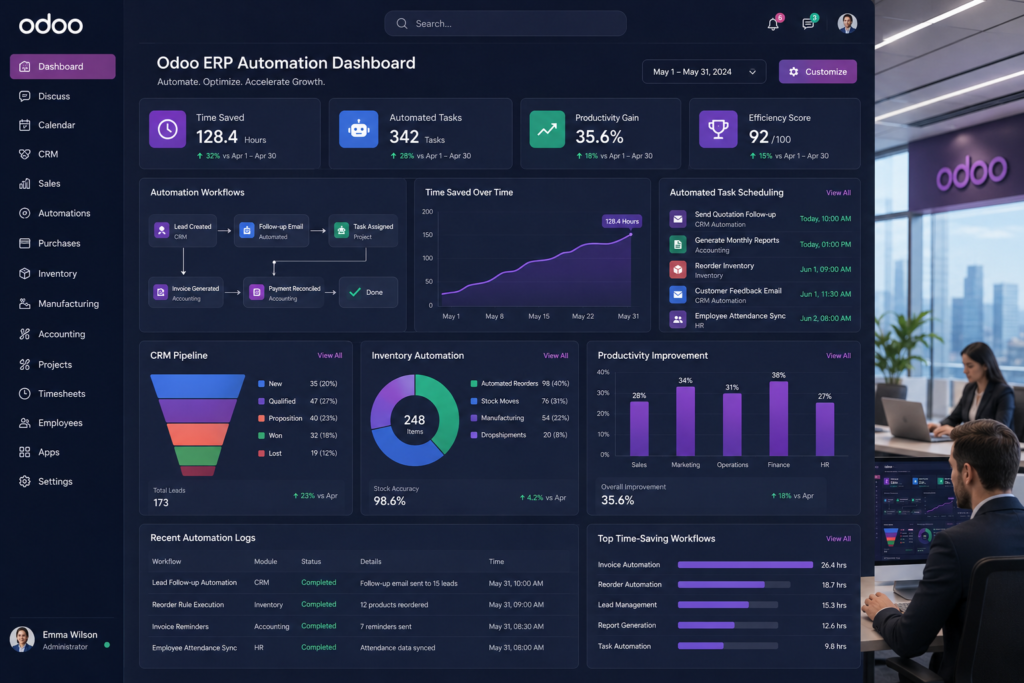





In today’s fast-moving business environment, time is one of the most valuable resources. Companies across the UK are constantly looking for ways to improve productivity, reduce manual workload, and streamline operations. This is where Odoo Automation plays a powerful role.
Odoo ERP Automation helps businesses eliminate repetitive manual tasks and replace them with intelligent workflows. From sales and CRM to accounting, inventory, HR, and customer support, Odoo transforms traditional business operations into fully automated systems.
Many organizations report saving 20+ hours per week after implementing Business Process Automation Odoo, allowing teams to focus on strategy, growth, and customer experience instead of routine administrative work.
In this blog, we will explore how Odoo achieves these time savings, which departments benefit the most, and how businesses can fully leverage automation to scale efficiently.
Why Businesses Waste So Much Time Without Automation
Before understanding how Odoo saves time, it is important to recognize where time is being lost.
Most businesses still rely on manual processes such as:
- Data entry in spreadsheets
- Manual email follow-ups
- Paper-based approvals
- Repetitive reporting
- Separate tools for each department
- Manual inventory tracking
- Disconnected communication systems
These inefficiencies lead to:
- Delayed decision-making
- Human errors
- Duplicate work
- Poor productivity
- Lost business opportunities
Without automation, employees spend a large portion of their time on repetitive tasks instead of value-driven work.
What is Odoo Automation?
Odoo Automation is a system that connects different business processes and automates repetitive tasks using predefined rules, workflows, and triggers.
Instead of manually performing tasks, Odoo executes them automatically based on conditions.
For example:
- When a lead is created → assign it automatically to a salesperson
- When an invoice is generated → send it automatically to the customer
- When stock is low → trigger automatic purchase order
- When a task is completed → notify manager instantly
This eliminates manual intervention and significantly improves efficiency.
How Odoo Saves 20+ Hours Per Week (Core Mechanisms)
1. CRM and Sales Automation
One of the biggest time-saving areas in Odoo is CRM automation.
Without automation, sales teams spend hours:
- Entering lead data
- Assigning leads manually
- Sending follow-up emails
- Tracking customer status
With Odoo CRM Automation:
- Leads are captured automatically from websites and forms
- Leads are assigned based on rules
- Follow-up emails are triggered automatically
- Sales pipeline updates in real time
Time Saved:
5–7 hours per week per sales team member
2. Automated Email and Communication Workflows
Communication is essential but time-consuming.
Odoo automates:
- Welcome emails
- Follow-up emails
- Payment reminders
- Order confirmations
- Customer notifications
This removes the need for manual messaging.
Businesses can also create scheduled campaigns that run automatically.
Time Saved:
3–5 hours per week
3. Accounting and Invoice Automation
Finance departments often spend hours on repetitive accounting tasks.
Odoo automates:
- Invoice generation
- Payment reminders
- Expense tracking
- Tax calculations
- Financial reporting
Instead of manually preparing reports, Odoo generates them in real time.
Time Saved:
4–6 hours per week
4. Inventory and Supply Chain Automation
For retail, manufacturing, and eCommerce businesses, inventory management is critical.
Odoo Automation helps by:
- Tracking stock levels in real time
- Generating purchase orders automatically
- Updating inventory after sales
- Managing warehouse operations
This reduces manual tracking significantly.
Time Saved:
3–6 hours per week
5. HR and Employee Management Automation
HR departments often deal with repetitive administrative tasks.
Odoo automates:
- Attendance tracking
- Leave approvals
- Payroll processing
- Employee onboarding workflows
Employees can submit requests, and approvals are handled automatically.
Time Saved:
2–4 hours per week
6. Project and Task Automation
Project management becomes more efficient with Odoo.
Automation includes:
- Task assignment
- Deadline reminders
- Progress tracking
- Status updates
Managers no longer need to manually follow up on every task.
Time Saved:
2–5 hours per week
7. Reporting and Analytics Automation
Reporting is one of the most time-consuming business activities.
Odoo generates:
- Sales reports
- Financial dashboards
- Performance analytics
- Inventory reports
All reports are updated in real time without manual effort.
Time Saved:
3–5 hours per week
Combined Time Savings: 20+ Hours Per Week
When all departments are combined, businesses typically save:
- CRM: 5–7 hours
- Communication: 3–5 hours
- Accounting: 4–6 hours
- Inventory: 3–6 hours
- HR: 2–4 hours
- Project management: 2–5 hours
- Reporting: 3–5 hours
Total Estimated Savings:
20 to 35 hours per week
This is equivalent to saving almost one full employee’s working time every week.
Real Business Impact of Odoo Automation
Time savings directly impact business performance.
1. Increased Productivity
Employees focus on:
- Strategy
- Customer relationships
- Sales growth
Instead of repetitive manual tasks.
2. Faster Decision-Making
Real-time dashboards help managers make quicker decisions.
3. Reduced Operational Costs
Less manual work means reduced labor costs and fewer errors.
4. Improved Customer Experience
Faster responses and automated communication improve satisfaction.
5. Higher Revenue Growth
More time spent on sales and strategy leads to increased revenue.
Role of Odoo Development Services in Automation
To achieve maximum efficiency, businesses need proper implementation.
At this stage, Odoo Development Services become essential.
Custom configuration allows businesses to:
- Build tailored workflows
- Integrate third-party tools
- Automate industry-specific processes
- Optimize performance
At Ambient Infotech, we specialize in designing automation systems that align with business goals and significantly reduce manual workload.
Industries That Benefit Most from Odoo Automation
Tourism and Travel
- Booking automation
- Customer management
- Inquiry handling
E-commerce
- Order processing
- Inventory tracking
- Customer notifications
Real Estate
- Lead management
- Property updates
- Client communication
Healthcare
- Appointment scheduling
- Patient records
- Billing automation
Manufacturing
- Production planning
- Supply chain management
- Inventory control
How Ambient Infotech Helps Businesses Save Time
We provide end-to-end automation solutions including:
- Odoo ERP Implementation
- Workflow Automation Design
- CRM Automation Setup
- Accounting Automation
- Inventory Optimization
- HR System Automation
- Custom Odoo Development Services
- AI Integration with Odoo
Our goal is to help businesses reduce manual workload and achieve measurable productivity improvements.
Future of Business Automation with Odoo
Automation is becoming the foundation of modern business operations.
Future trends include:
- AI-powered decision-making
- Predictive analytics
- Fully autonomous workflows
- Voice-enabled ERP systems
- Hyper-personalized customer automation
Businesses that adopt automation early will gain a strong competitive advantage.
Final Thoughts
Odoo Automation is not just a productivity tool—it is a complete business transformation system. By eliminating repetitive tasks and streamlining workflows, businesses can save 20+ hours per week, reduce operational costs, and improve overall efficiency.
With the right implementation of Odoo ERP Automation and professional Odoo Development Services, companies can scale faster and operate more intelligently.
Organizations that invest in automation today will be better positioned for long-term success in an increasingly competitive digital economy.